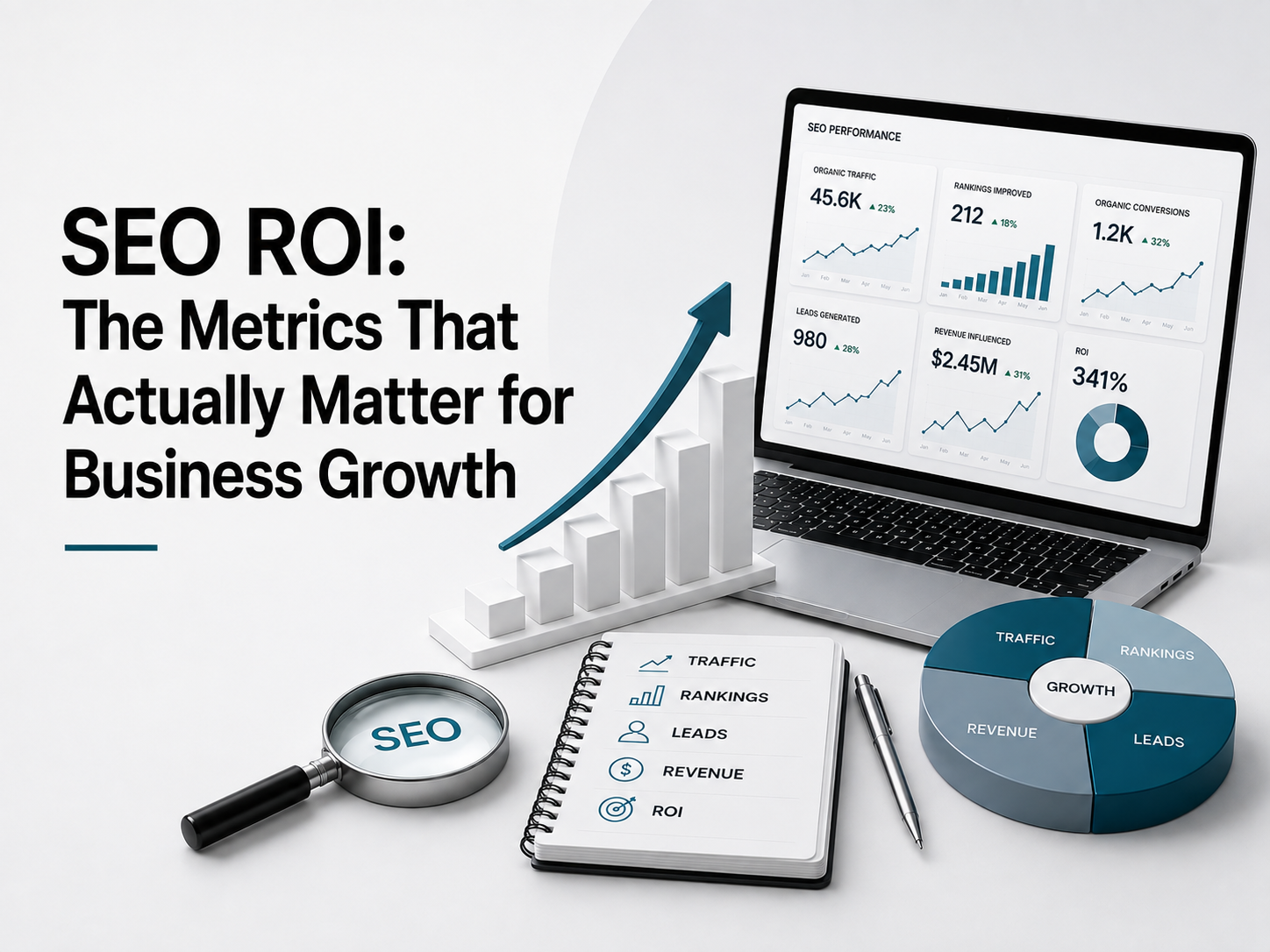
SEO reports often contain plenty of numbers: rankings, impressions, clicks, organic traffic, and keyword movements. These metrics are useful for understanding search performance, but they don’t always answer the question leadership teams care about most:
Is SEO contributing to business growth?
A website can gain thousands of organic visits without generating meaningful leads or sales. At the same time, a smaller increase in highly relevant organic traffic can create significant commercial value.
This makes SEO ROI more than a traffic or ranking exercise. Businesses need to understand how search visibility contributes to customer acquisition, leads, pipeline, revenue, and long-term growth.
For CEOs and CMOs, the goal of SEO reporting should be clear: understand what changed, what business value it created, and where the next opportunity lies.
At Design Brewery, this is an important distinction in how SEO performance is evaluated. If an SEO report starts and ends with traffic, it is measuring channel activity rather than business impact.
What Is SEO ROI?
SEO ROI measures the business value generated through organic search in relation to the investment made in SEO.
A simple way to express it is:
SEO ROI = (Value generated from SEO − SEO investment) ÷ SEO investment × 100
The challenge lies in defining the “value generated.”
For an ecommerce business, this may include organic revenue and purchases. For a B2B company, the value may appear through qualified leads, sales opportunities, or pipeline influenced by organic search.
SEO can also contribute to conversions that happen later through another channel. A customer may discover a company through Google, return through a branded search, and eventually convert after interacting with an email or sales representative.
This means SEO ROI should consider both direct and assisted business outcomes.
The right measurement model depends on the business model, sales cycle, conversion journey, and role SEO plays within the broader marketing mix.
Why Is SEO ROI Difficult to Measure?
SEO has a measurement challenge that differs from many short-term marketing channels. Search visibility can take time to build, and the value of an SEO investment may continue accumulating after the initial work is completed.
Several factors make attribution more complex.
SEO Has a Longer Impact Curve
A new landing page, content asset, or technical improvement may take weeks or months to reach its full potential. Measuring its value immediately can underestimate its contribution.
Customers Use Multiple Touchpoints
A customer might discover a brand through organic search, visit the website several times, engage with social content, receive an email, and then convert through a direct visit.
Organic search may have played an important role even when it was not the final conversion channel.
Branded and Non-Branded Search Tell Different Stories
Branded searches often represent existing awareness. Non-branded search performance provides stronger insight into how effectively SEO is helping a brand reach people who may not have known about it previously.
For many growth-focused SEO programmes, increasing relevant non-branded visibility is therefore an important indicator.
Traffic Quality Matters
10,000 additional visitors do not automatically create more business value.
A smaller volume of visitors searching for high-intent terms can be significantly more valuable than a large audience with little connection to the product or service.
Different Businesses Have Different Conversion Paths
A B2B software company may need several interactions before a prospect becomes a customer. An ecommerce brand may see a purchase within the same session.
SEO ROI needs to account for these differences rather than applying one measurement model to every business.
SEO Metrics vs Business Outcomes
SEO generates a large amount of data, but every metric serves a different purpose. Some metrics help diagnose search performance, while others show the business value created through organic search.
Understanding this distinction makes SEO reporting more useful for leadership teams.
| SEO Metric |
What It Tells You |
Business Relevance |
| Impressions |
How often pages appear in search results |
Indicates search visibility |
| Keyword rankings |
Where the website appears for target queries |
Shows competitiveness for relevant searches |
| Organic clicks |
How many users visit from search |
Shows whether search visibility is generating visits |
| Non-branded organic traffic |
Visits from people searching for generic terms |
Indicates discovery beyond existing brand awareness |
| Conversion rate |
Percentage of organic visitors completing a desired action |
Shows the quality and relevance of organic traffic |
| Qualified leads |
Number of leads that meet business criteria |
Shows potential commercial value |
| Pipeline influenced |
Sales opportunities connected to organic search |
Connects SEO with B2B revenue potential |
| Organic revenue |
Revenue attributed to organic search |
Measures direct commercial contribution |
The value of these metrics increases when they are interpreted together.
For example, higher rankings with declining conversions may indicate a mismatch between search intent and landing-page experience. Strong traffic growth with limited qualified leads may indicate that the content is attracting a broader audience than the business can serve.
This is why an effective SEO report should explain what the numbers mean and what action they suggest.
The SEO ROI Funnel: From Visibility to Revenue
SEO performance can be understood through a simple progression:
Visibility → Traffic → Intent → Conversion → Business Impact → ROI
Each stage answers a different business question.
1. Visibility: Are We Being Found?
Impressions and relevant keyword visibility show whether the brand is appearing for searches that matter to the business.
Ranking improvements are valuable when they occur for queries connected to the target audience, products, services, or commercial opportunities.
2. Traffic: Are People Choosing Us?
Clicks and organic sessions show whether search visibility is translating into website visits.
At this stage, non-branded organic growth is particularly useful for understanding whether SEO is expanding the brand’s reach.
3. Intent: Are We Attracting the Right Audience?
Traffic quality depends on search intent.
Someone searching for “what is CRM software” has a different commercial intent from someone searching for “CRM software for small businesses.”
SEO performance improves when content and landing pages attract users whose needs align with the business offering.
4. Conversion: Are Visitors Taking Valuable Actions?
The desired action depends on the business.
It could be:
- Product purchase
- Demo request
- Consultation enquiry
- Lead form submission
- Account registration
- Phone call
- Newsletter signup
Conversion data helps connect organic traffic with measurable customer actions.
5. Business Impact: Is SEO Creating Commercial Value?
This is where SEO connects with business performance.
Depending on the business model, the outcome may include qualified leads, sales opportunities, pipeline, purchases, revenue, or customer acquisition.
6. ROI: Is the Investment Generating Sufficient Value?
The final question brings the entire funnel together.
Businesses can compare the value generated through organic search with the cost of SEO resources, content production, technology, agency fees, and implementation.
The funnel also helps identify where performance needs attention. A business with strong visibility but weak conversions has a different SEO opportunity from one with strong conversions but limited search visibility.
Visual Opportunity: Create an SEO ROI funnel graphic showing Visibility → Traffic → Intent → Conversion → Business Impact → ROI, with 1–2 example metrics under each stage.
The SEO Metrics That Actually Matter
Not every metric deserves equal attention in a leadership report. The most useful metrics are the ones that help explain growth, quality, commercial contribution, and efficiency.
Non-Branded Organic Growth
Non-branded traffic shows how effectively SEO is helping the business reach people who are searching for products, services, problems, or solutions without already using the brand name.
This makes it particularly useful for measuring new demand capture and market discovery.
For example, an ecommerce brand ranking for “best cotton bedsheets” is reaching a different audience from someone searching directly for the brand name.
Relevant Keyword Visibility
Overall keyword count provides limited insight into SEO performance.
A more useful view considers whether the website is gaining visibility for commercially relevant and strategically important queries.
Moving from page three to page one for a high-intent service keyword can have far greater business value than ranking for hundreds of low-value terms.
Organic Landing-Page Performance
Looking at which pages attract organic traffic helps identify where SEO is creating demand.
For a B2B website, this could include service pages, industry pages, solution pages, or case studies. For a B2C brand, category and product pages may play a larger role.
Page-level analysis also helps identify opportunities for better internal linking, stronger CTAs, content improvements, and conversion optimization.
Conversion Rate From Organic Traffic
Traffic becomes commercially meaningful when visitors take valuable actions.
Tracking organic conversion rate helps answer an important question:
Are the visitors coming through SEO taking actions that matter to the business?
A decline in conversion rate alongside strong traffic growth deserves investigation. Search intent, landing-page relevance, user experience, messaging, and conversion paths can all influence the outcome.
Qualified Conversions
For lead-generation businesses, total form submissions provide only part of the picture.
A website may generate 100 enquiries, but if only 10 meet the ideal customer profile, those 10 qualified leads provide a more useful measure of SEO’s commercial value.
This makes collaboration between SEO, marketing, and sales teams important when evaluating performance.
Revenue and Pipeline
Revenue provides a direct commercial measure for businesses where organic conversions can be tracked reliably.
For B2B businesses, pipeline influenced by organic search can provide a more realistic picture because the customer journey often extends across multiple interactions and sales conversations.
These metrics help move SEO reporting from search performance to business performance.
How SEO ROI Differs for B2B and B2C Brands
SEO plays a different role depending on how customers discover, evaluate, and purchase from a business. The measurement framework should reflect that customer journey.
| |
B2B Brands |
B2C Brands |
| Primary business outcome |
Qualified leads and pipeline |
Purchases and revenue |
| Typical journey |
Research → evaluation → sales conversation → purchase |
Discovery → consideration → purchase |
| Important SEO contribution |
Lead generation, demand capture and sales enablement |
Product discovery, demand capture and transactions |
| Useful conversion signals |
Demo requests, enquiries, consultation requests |
Purchases, registrations, subscriptions |
| Additional business signals |
Lead quality, sales opportunities, pipeline influenced |
Conversion rate, average order value, repeat purchases |
| Attribution considerations |
Longer sales cycles and multiple stakeholders |
Multiple sessions, devices and marketing channels |
For B2B Brands
A B2B company may receive significant organic traffic without generating a large number of immediate conversions. A prospect may discover a service page, return later through a branded search, download a resource, speak with sales, and become a customer several weeks or months later.
SEO measurement should therefore connect organic search with lead quality and pipeline progression.
For example, 50 organic enquiries may appear strong in a monthly report. If only five become qualified opportunities, those five provide a more meaningful indication of business value.
For B2C Brands
B2C brands often have a more direct connection between search and purchase, particularly in ecommerce and other transactional categories.
Organic search can influence product discovery, category exploration, comparison, and purchase decisions.
Revenue, organic conversion rate, product/category performance, average order value, and repeat purchases can therefore provide useful context alongside search visibility and traffic.
The important principle across both models is measurement aligned with the customer’s actual path to purchase.
How to Build an SEO ROI Dashboard for Leadership
A leadership dashboard should make SEO performance easy to understand within a few minutes. It should provide enough information to support decisions without turning into a collection of disconnected metrics.
A practical structure can follow four sections:
1. Search Growth
Show the change in organic visibility and traffic.
Include metrics such as:
- Organic clicks
- Non-branded clicks
- Relevant keyword visibility
- Organic landing-page growth
- Growth compared with the previous period or year
This section establishes whether SEO is expanding the brand’s presence in search.
2. Business Outcomes
Connect organic search with meaningful customer actions.
Depending on the business, this could include:
- Qualified leads
- Demo or consultation requests
- Purchases
- Organic revenue
- Pipeline influenced
- Conversion rate
This is the section leadership should spend the most time evaluating.
3. Key Insights
Numbers become more useful when the report explains why they changed.
For example:
Non-branded organic clicks increased by 28% after category and service pages gained visibility for high-intent searches.
Or:
Organic traffic increased, while qualified leads remained flat. Landing-page relevance and conversion paths are the next areas to investigate.
This turns reporting into analysis.
4. Next Actions
Every report should lead to clear priorities for the next period.
These might include:
- Expanding a high-performing topic cluster
- Improving underperforming landing pages
- Strengthening internal linking
- Creating content for emerging search demand
- Improving conversion paths
- Building authority around priority topics
- Expanding SEO and GEO visibility
The dashboard then becomes a decision-making tool, rather than a monthly record of SEO activity.
Visual Opportunity: Create a sample leadership dashboard with four blocks: Search Growth → Business Outcomes → Key Insights → Next Actions. This can also be repurposed as a LinkedIn carousel or downloadable SEO reporting template.
What a Good SEO Report Should Tell a CEO or CMO
A strong SEO report should help leadership understand the business story behind the data.
Within a few minutes, a CEO or CMO should be able to answer five questions:
What changed?
How did organic visibility, traffic, leads, sales, or revenue move?
- Why did it change?
Which pages, content initiatives, technical improvements, or market factors contributed to the movement?
- What business impact did SEO create?
Did organic search generate qualified leads, sales, revenue, or pipeline?
- Where is the next opportunity?
Which topics, pages, markets, products, or search trends have the strongest growth potential?
- What happens next?
Which actions should the SEO and marketing teams prioritise in the coming period?
This approach also creates better conversations between leadership and the SEO team. Instead of reviewing dozens of rankings, the discussion can focus on growth, opportunities, challenges, and investment decisions.
A useful SEO report should therefore combine performance data with interpretation and action.
The Design Brewery Perspective: Measure SEO as a Growth Channel
Design Brewery approaches SEO as a growth channel that connects search visibility, content, website experience, conversions, and business outcomes.
This becomes particularly important as search behaviour evolves. Traditional organic search continues to matter, while AI-driven discovery is creating additional opportunities for brands to become visible across platforms such as Google AI experiences, ChatGPT, Gemini, and Perplexity.
A strong SEO programme therefore needs a broader view of performance.
For example, an increase in non-branded organic visibility can indicate that a brand is reaching new audiences. Growth in qualified organic leads can demonstrate stronger alignment between search intent and business offerings. Improvements in organic revenue can provide a direct commercial signal.
The right measurement framework also helps teams decide where to invest next. High-performing content can reveal opportunities for deeper topical coverage. Pages with strong organic traffic but weak conversions can highlight CRO opportunities. Growing search demand can identify new content or landing-page opportunities.
For Design Brewery, the goal is to connect these insights into a measurable SEO and GEO growth framework.
SEO performance becomes more valuable when the data helps answer a broader business question:
Where is organic search creating growth, and where can the next investment create more?
SEO ROI: From Rankings to Business Growth
SEO has many measurable outputs, but its ultimate value comes from the business outcomes those activities support.
Rankings can show progress. Traffic can show demand. Conversions can show action. Revenue and pipeline can show commercial impact.
Looking at these signals together creates a much clearer picture of SEO ROI.
The most effective measurement approach is therefore built around a simple progression:
Search visibility → Relevant traffic → Valuable actions → Business outcomes → ROI
When this framework is applied consistently, SEO reporting becomes more than a monthly performance update. It becomes a tool for identifying opportunities, allocating resources, and making better marketing decisions.
Is Your SEO Reporting Showing Business Impact?
Design Brewery helps businesses build SEO and GEO strategies around measurable growth, from search visibility and content performance to qualified leads, conversions, and revenue.
If your current SEO reporting is heavily focused on rankings and traffic, it may be worth evaluating how those numbers connect to the outcomes that matter most to your business.