Keyword research has traditionally focused on identifying the terms people enter into search engines, estimating search volumes, and understanding the intent behind those searches. But as customers increasingly use AI platforms such as ChatGPT, Gemini, and Perplexity to research products, compare services, and find recommendations, businesses need to expand how they approach keyword research.
A potential customer might search Google for “best CRM software for small businesses” but ask an AI platform, “Which CRM should a 10-person sales team choose if it needs affordable pricing and easy integration with existing tools?”
Both queries reflect a similar need, but the second provides more context about the customer’s requirements and decision-making process.
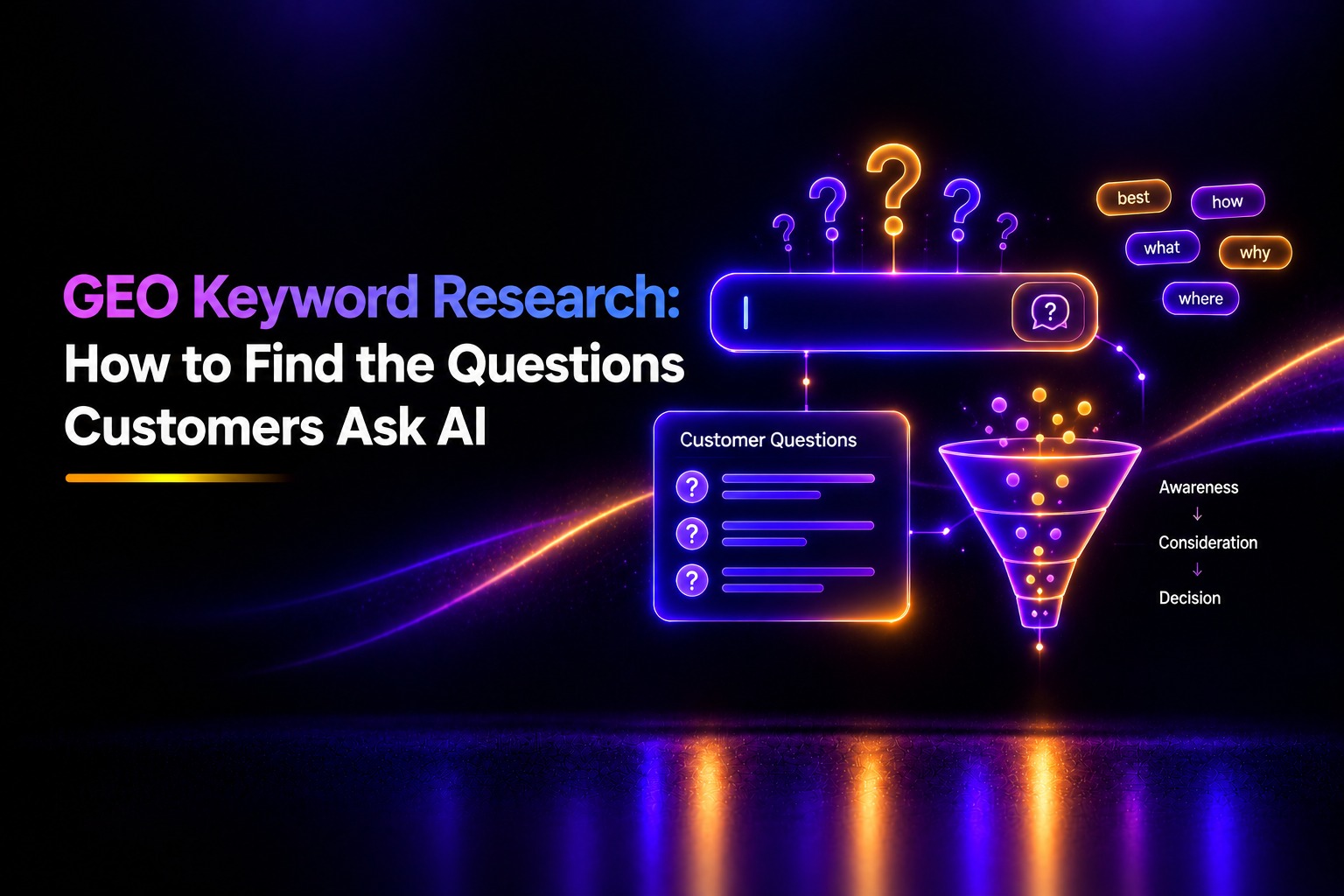
This is where GEO keyword research becomes important. It helps businesses identify the questions, problems, comparisons, and use cases customers bring to AI platforms, then use those insights to build content that answers their needs.
Traditional keyword research remains valuable. The goal is to combine search data with customer questions, conversational queries, and AI prompt research to develop a more complete content strategy for both B2B and B2C audiences.
What Is GEO Keyword Research?
GEO (Generative Engine Optimization) keyword research is the process of identifying the topics, questions, and conversational queries that people use when researching information through AI-powered search and answer platforms.
Rather than focusing only on individual keywords, it examines the broader context behind a search: what the customer wants to achieve, which options they are considering, what problems they need to solve, and what information might influence their decision.
For example, a company selling payroll software might target the keyword “payroll software.” GEO keyword research expands this into questions such as:
- Which payroll software is suitable for a small business in India?
- How can a company reduce payroll errors and simplify compliance?
- What should a business look for when comparing payroll software?
- Which payroll tools integrate with existing HR systems?
These questions help identify content opportunities that address customers at different stages of their decision-making journey.
How GEO Keyword Research Differs from Traditional Keyword Research
| Traditional keyword research |
GEO keyword research |
| Focuses on keywords, search volume, and ranking difficulty |
Combines keywords with customer questions, prompts, and use cases |
| Often starts with short search terms |
Expands into conversational and context-rich queries |
| Groups keywords primarily by topic and search intent |
Also considers audience, scenario, constraints, and decision criteria |
| Helps plan pages for organic search visibility |
Helps plan useful content that can answer questions across AI-assisted discovery |
| Uses rankings, impressions, clicks, and conversions to measure performance |
Can additionally track brand mentions, recommendations, and citations across selected AI platforms |
The two approaches complement each other. Search data helps establish what people actively look for, while conversational research helps uncover the context behind their needs.
Why Search Intent Matters More Than Exact Wording
Customers can express the same need in several ways. Someone looking for CRM software might search for “best CRM for small businesses,” “affordable CRM for startups,” or “CRM for a 10-person sales team.”
Although the wording differs, these queries share a common theme: finding a suitable CRM solution. However, each also introduces a different consideration, such as budget, business size, or team requirements.
GEO keyword research should therefore group related questions by underlying intent rather than treating every variation as a separate content opportunity.
This helps businesses identify the information customers need, decide which questions belong on the same page, and avoid creating multiple pages that answer essentially the same question.
What Types of Queries Should GEO Keyword Research Cover?
A strong GEO keyword research process goes beyond broad product or service terms. It considers how customers describe their problems, evaluate available options, and narrow down their choices.
1. Conversational and Long-Form Questions
Customers often provide more context when asking AI platforms for help. Instead of entering a short keyword, they may describe their situation and ask for a recommendation.
Examples include:
- How do I choose an accounting tool for a growing business?
- What features should I look for in a beginner-friendly camera?
- Which project management software works best for a remote team?
These queries can reveal opportunities for detailed guides, FAQs, comparison pages, and solution-focused content.
2. Problem-Based Searches
Customers frequently begin their research with a problem rather than a product name. Understanding these problems helps businesses create content that meets users earlier in their decision-making journey.
For example:
- How can a business reduce employee payroll errors?
- Why does my mattress feel uncomfortable after a few months?
- How can I remove stains from office shirts without damaging the fabric?
Problem-based queries can inform educational articles, troubleshooting guides, product explainers, and service pages.
3. Comparison and Recommendation Queries
Customers use comparison questions to evaluate alternatives and understand which option suits their requirements.
Examples include:
- Which CRM is better for a small sales team?
- What is the difference between cloud-based and on-premise ERP software?
- Which smartphone offers the best camera under ₹15,000?
These queries are particularly useful for comparison articles, alternatives pages, buying guides, and product or service pages that clearly explain differentiators.
4. Budget, Audience, and Use-Case Queries
Customers rarely evaluate a solution in isolation. Their budget, experience level, industry, and intended use can significantly influence their choices.
Examples include:
- Best payroll software for a 50-person company in India
- Which mattress is suitable for people who prefer a firm sleeping surface?
- What are the best smartphones under ₹15,000 for photography?
Including these modifiers in GEO keyword research helps businesses identify more specific content opportunities and address the practical criteria customers use when making decisions.
How to Find Customer Questions for GEO Keyword Research
Identifying the right questions is the foundation of GEO keyword research. Rather than relying on a single keyword tool or manually testing a few prompts, businesses should combine search data, customer feedback, competitor research, and conversational query exploration.
1. Start With Seed Keywords
Begin with the core products, services, categories, and problems your business addresses. These seed keywords provide a starting point for discovering related questions.
For example, a payroll software company might start with:
- Payroll software
- Payroll automation
- Payroll compliance
- HR and payroll integration
- Employee salary management
An e-commerce brand selling smartphones might start with “budget smartphones,” “smartphone battery life,” and “phones with good cameras.”
The goal is to move from broad topics to the specific questions customers might ask while researching solutions.
2. Use Search Data and Customer Language
Existing SEO data is a valuable source of customer questions. Review Google Search Console, keyword research tools, website search data, and customer-facing resources to identify recurring queries and information gaps.
Useful sources include:
- Google Search Console: Find queries generating impressions and clicks, including longer searches that reveal specific needs.
- Keyword research tools: Explore related keywords, question-based queries, and variations around a core topic.
- Sales and customer support conversations: Identify recurring objections, product concerns, implementation questions, and purchase criteria.
- FAQs and product reviews: Understand what customers want to know before buying and what they consider important after using a product.
- Competitor content: Identify questions addressed by competing brands and topics where useful information may be missing.
Customer language is especially useful because it often reveals the actual problem behind a search. A business might describe its offering as “payroll automation software,” while customers may ask how to calculate salaries accurately or manage payroll compliance.
Both perspectives should inform the research.
3. Explore Questions Across AI Platforms
Manually explore relevant topics on platforms such as ChatGPT, Gemini, and Perplexity to understand how a customer might research a product or service through AI.
Start with broad questions and follow up with more specific ones. For example:
- What should a small business consider when choosing payroll software?
- Which payroll features are most useful for a growing company?
- How should a business compare payroll software pricing?
- What questions should a company ask before switching payroll providers?
Observe the criteria, concerns, comparisons, and follow-up questions that emerge. These can help you identify content opportunities and refine your prompt library.
However, questions tested manually on AI platforms do not establish actual search volume or prove how frequently customers ask them. Treat them as qualitative research inputs and validate them against keyword data, customer conversations, and other available evidence.
4. Expand Each Keyword into Conversational Variations
Once you have your seed keywords and initial questions, expand them by changing the context in which a customer might need a solution.
For each topic, explore variations based on:
- Problem: What challenge is the customer trying to solve?
- Audience: Who needs the solution?
- Budget: What price range or investment limit applies?
- Use case: What does the customer need the product to do?
- Comparison: Which alternatives are being considered?
- Purchase stage: What does the customer need to know before choosing?
For instance, the seed keyword “project management software” could lead to questions about managing remote teams, tracking project deadlines, comparing free and paid tools, or choosing software for an agency.
This approach helps uncover a broader range of customer needs without generating endless keyword variations that offer little additional value.
5. Group Questions by Search Intent
Before turning your research into content, organise related queries by the purpose behind them.
| Intent |
Example question |
Potential content |
| Informational |
What is payroll automation? |
Educational guide |
| Problem-solving |
How can a company reduce payroll errors? |
How-to article |
| Comparison |
How do different payroll tools compare? |
Comparison page |
| Recommendation |
Which payroll software suits a small business? |
Buying guide |
| Purchase-focused |
What features and integrations does this payroll platform offer? |
Product or service page |
This grouping helps identify the right format for answering each question and prevents unnecessary duplication across the content strategy.
How to Turn Keywords Into an AI Prompt Set
A keyword list is useful for discovering topics, but it does not fully capture the different ways customers explore those topics through AI. The next step is to convert relevant keywords into a structured set of prompts that represent realistic customer questions.
Build Prompts Around Real Customer Decisions
Start with one seed keyword and develop prompts that reflect different needs, levels of knowledge, and decision-making criteria.
For example, a business researching payroll software could use the following prompt set:
| Research angle |
Example AI prompt |
| Understanding the category |
How does payroll software help small businesses manage employee salaries? |
| Solving a problem |
How can a growing company reduce payroll errors and manual calculations? |
| Evaluating features |
Which payroll software features are essential for a business with 50 employees? |
| Comparing options |
What should a business compare when evaluating payroll software providers? |
| Considering compliance |
What should Indian businesses look for in payroll software to manage compliance requirements? |
| Evaluating integrations |
How can payroll software integrate with existing HR and attendance systems? |
These prompts represent different information needs around the same core topic. They can help identify whether the existing website adequately answers customer questions or needs additional guides, comparisons, FAQs, or product information.
Create a Structured Prompt Library
Maintain a spreadsheet that connects each customer question to its business relevance and the content intended to address it.
Recommended fields include:
- Seed keyword: The original product, service, or topic.
- Customer question: The need or problem expressed in natural language.
- AI prompt: The specific question used for research or visibility testing.
- Intent: Informational, problem-solving, comparison, recommendation, or purchase-focused.
- Audience: The customer segment or decision-maker.
- Funnel stage: Awareness, consideration, or decision.
- Target page: The existing or planned page that should answer the question.
- Priority: The relative importance of the opportunity to the business.
A structured prompt library makes GEO research more actionable. It connects customer questions with content planning and provides a consistent set of prompts for checking brand visibility across selected AI platforms over time.
How GEO Keyword Research Differs for B2B and B2C
Although the fundamentals of GEO keyword research remain similar across industries, the questions customers ask can vary significantly between B2B and B2C businesses. The difference lies in the audience, the complexity of the purchase, and the criteria used to evaluate a solution.
Understanding these differences helps businesses build prompt libraries and content strategies that reflect how their customers actually make decisions.
GEO Keyword Research for B2B Businesses
B2B customers often evaluate products and services based on business requirements, operational challenges, integration capabilities, implementation complexity, and long-term value. Their research may involve multiple stakeholders, making detailed and industry-specific questions particularly important.
For example, someone researching enterprise software may ask:
- Which CRM software is suitable for a B2B sales team of 20 people?
- What should a manufacturing company consider when choosing an ERP system?
- Which HR software integrates with existing payroll and attendance tools?
- How can a mid-sized company evaluate cybersecurity solutions for its infrastructure?
To identify these questions, B2B businesses should examine sales calls, product demonstrations, RFPs, customer support conversations, competitor comparisons, and common objections raised during the buying process.
The research should also account for industry terminology and the concerns of different decision-makers. A technology leader may focus on integrations and security, while a business head may prioritise efficiency, scalability, and cost.
Content opportunities for B2B GEO include:
- Detailed solution and service pages
- Industry-specific landing pages
- Product and competitor comparison pages
- Integration and implementation guides
- Case studies addressing specific business challenges
- Educational content explaining complex concepts
The objective is to provide clear, credible answers that help potential buyers understand the solution and evaluate whether it meets their requirements.
GEO Keyword Research for B2C Businesses
B2C customers generally focus on personal needs, product suitability, pricing, features, convenience, and value for money. Their questions often include specific preferences, lifestyle requirements, and budget constraints.
For example, customers researching consumer products might ask:
- Which smartphone under ₹15,000 offers the best camera?
- What type of mattress is suitable for someone who prefers a firm sleeping surface?
- Which shirts are best for office wear and resist everyday stains?
- What should I consider when choosing skincare products for oily skin?
B2C businesses can discover these questions by analysing product reviews, customer FAQs, marketplace questions, support queries, comparison searches, and recurring purchase objections.
Budget and feature modifiers are particularly useful because they help identify the criteria customers use to narrow their choices. Research should also consider differences in experience level, lifestyle, product usage, and purchase intent.
Content opportunities for B2C GEO include:
- Product and collection pages
- Buying guides and product comparisons
- FAQs addressing common purchase concerns
- Product explainers and how-to articles
- Use-case and problem-solving content
- Care, maintenance, and troubleshooting guides
For B2C brands, the goal is to help customers understand which products suit their needs, how available options differ, and what they should consider before purchasing.
What Both Approaches Have in Common
B2B and B2C GEO keyword research should start with the same foundation: seed keywords, customer language, search data, question discovery, intent grouping, and prompt development.
The main difference is the context used to expand the research.
| Research element |
B2B focus |
B2C focus |
| Primary need |
Solve a business problem |
Meet a personal or household need |
| Decision criteria |
Integration, scalability, implementation, ROI |
Price, features, suitability, convenience |
| Useful research sources |
Sales calls, demos, RFPs, customer objections |
Reviews, FAQs, product questions, support queries |
| Query modifiers |
Industry, company size, workflow, compliance |
Budget, features, lifestyle, intended use |
| Content priorities |
Solution pages, industry pages, case studies |
Product pages, buying guides, comparisons |
These distinctions help businesses avoid using a generic prompt strategy across every audience. The more closely the research reflects actual customer decisions, the more useful it becomes for content planning.
How to Map AI Prompts to Content
Once you have collected and grouped customer questions, the next step is to connect them to relevant website content. The aim is not to create a separate page for every prompt, but to ensure that important customer needs are answered in the most appropriate place.
Start by reviewing your existing pages and identifying which questions they already address. Then map unanswered questions to new content opportunities.
| Question type |
Recommended content format |
| Basic informational questions |
Educational articles and explainers |
| Problem-solving questions |
How-to guides and troubleshooting content |
| Comparison questions |
Comparison pages and alternatives guides |
| Product recommendation questions |
Buying guides and relevant product or service pages |
| Industry-specific B2B questions |
Industry landing pages and case studies |
| Feature, pricing, or integration questions |
Detailed product and service pages |
For example, a payroll software company may already have a product page describing its core features. That page can answer questions about integrations, automation, and supported workflows, while a separate educational article can explain how businesses can reduce payroll errors.
Similarly, an e-commerce brand may use product pages to explain specifications and benefits, while a buying guide helps customers compare products based on budget or intended use.
Identify Content Gaps and Overlaps
During mapping, look for three common opportunities:
- Content gaps: Important customer questions that are not adequately answered anywhere on the website.
- Content improvements: Existing pages that cover a topic but lack clear explanations, useful comparisons, or relevant details.
- Content overlaps: Multiple pages targeting essentially the same need without offering distinct value.
Prioritise content that addresses meaningful customer needs and supports business objectives. Avoid creating pages solely to target individual prompt variations when a comprehensive, well-structured page can answer several related questions.
How to Prioritise GEO Keywords and Prompts
A GEO keyword research project can generate hundreds of potential questions. Trying to create content for every question is neither practical nor necessary. Prioritisation helps businesses focus on the opportunities most relevant to their audience and commercial goals.
Evaluate each question against the following criteria:
- Business relevance: Does the question relate directly to your products, services, or expertise?
- Customer value: Does answering it help customers understand a problem or make a better decision?
- Search evidence: Is there supporting evidence from keyword data, Search Console, customer conversations, or other research sources?
- Content gap: Is the question missing from your website or inadequately addressed?
- Purchase relevance: Could answering the question support product discovery, consideration, or conversion?
- Ability to provide a credible answer: Can your business offer useful, accurate information supported by product knowledge, expertise, or evidence?
Once priorities are established, select a manageable set of prompts to test across relevant AI platforms. Record whether your brand appears, which competitors are mentioned, what sources are cited, and whether your existing content is referenced.
These checks can establish a baseline for monitoring visibility over time. However, AI responses can vary by platform, prompt wording, and context, so individual results should be treated as directional observations rather than fixed rankings.
How Design Brewery Approaches GEO Keyword Research
At Design Brewery, GEO keyword research goes beyond identifying keywords with search potential. The focus is on understanding what customers want to know, how they evaluate different solutions, and what information they need before making a decision.
Our approach combines traditional keyword research, customer questions, competitor analysis, product or service knowledge, and conversational prompt research to identify meaningful content opportunities.
We then organise these insights by search intent, audience, and buying stage, mapping them to relevant product pages, service pages, comparison articles, case studies, and educational content.
For B2B businesses, this may involve identifying industry-specific questions, implementation concerns, and solution comparisons. For e-commerce brands, it may mean researching product suitability, feature comparisons, budget-based recommendations, and use-case queries.
This process creates a structured content roadmap that supports both organic search visibility and a brand’s discoverability across AI-powered search experiences.
Conclusion
GEO keyword research is an extension of traditional keyword research, not a replacement for it. While search volume and keyword rankings remain useful, businesses also need to understand the questions customers ask, the problems they want to solve, and the criteria they use to evaluate solutions.
A practical approach starts with seed keywords, expands into conversational questions, groups those questions by intent, and converts them into structured AI prompt sets. These prompts can then be mapped to existing content, used to identify content gaps, and prioritised according to customer needs and business relevance.
The process should also reflect the differences between B2B and B2C audiences, ensuring that content addresses the right questions for each type of customer.
Ultimately, effective GEO keyword research connects what customers want to know with the information a business can credibly provide. This gives brands a clearer foundation for creating useful content and evaluating their visibility across both traditional search engines and AI-powered discovery platforms.