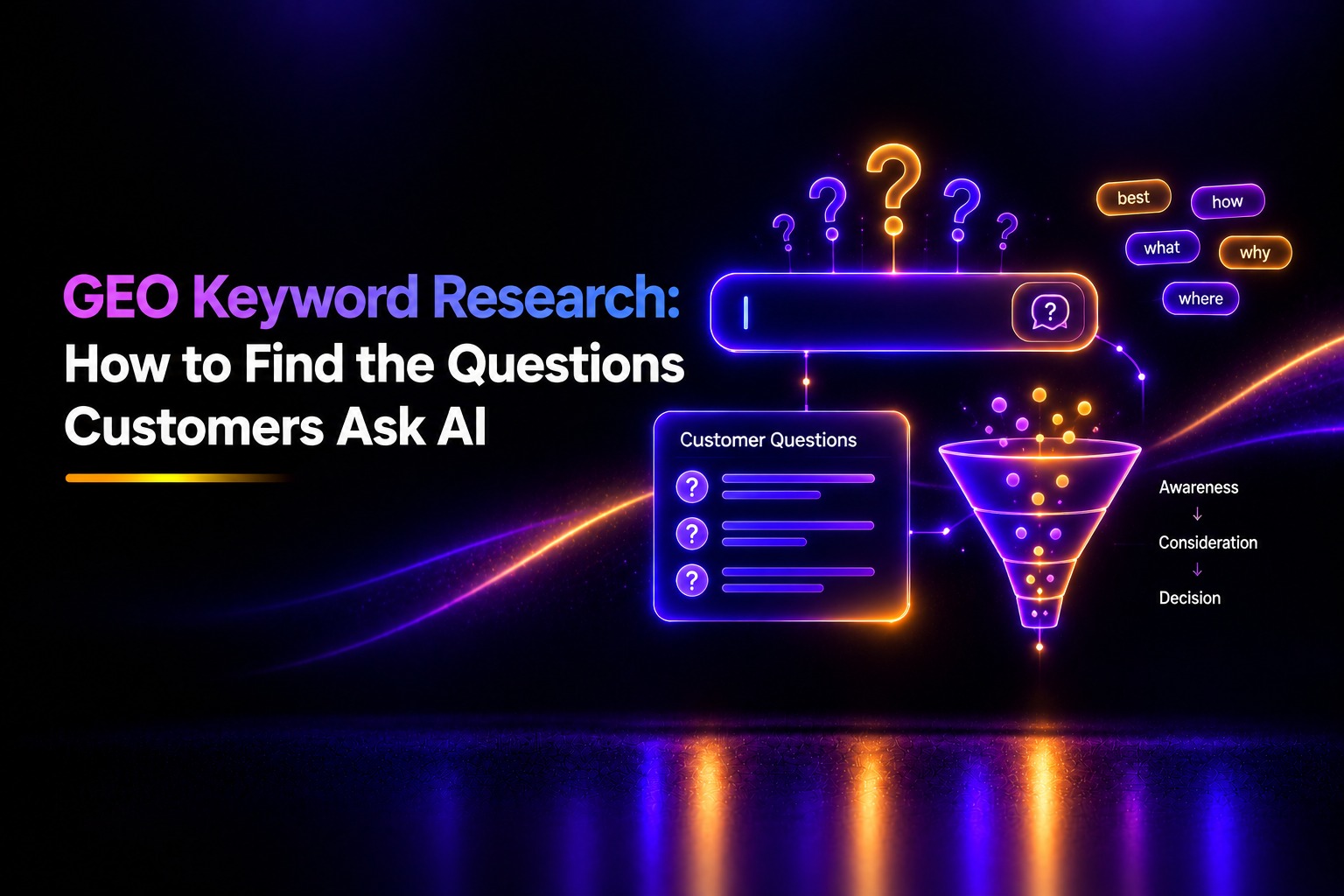
Customers increasingly use AI-powered platforms such as ChatGPT, Gemini, and Perplexity to research products, compare options, and find answers to specific questions. Instead of searching only for broad keywords, they often ask conversational questions that reflect their needs and purchasing decisions.
For businesses, this creates an opportunity to make website content more useful and accessible. Frequently Asked Questions (FAQs) help address customer concerns, clarify product information, and complement the content on product and category pages.
This is where FAQs can support Generative Engine Optimization (GEO) and Answer Engine Optimization (AEO). However, simply adding FAQs does not guarantee AI visibility. Their value lies in providing accurate, relevant answers to questions customers genuinely ask.
How FAQs Support GEO and Answer Engine Optimization
FAQs organise information around specific questions, making it easier for customers to find relevant details without reading an entire page. They can also help clarify information that may not fit naturally into the main product description.
For example, a product page may list a curtain’s material and dimensions, while its FAQs explain care instructions or suitability for different rooms.
Well-written FAQs can support GEO and AEO in several ways:
- Answer specific questions: Address common concerns about product features, compatibility, usage, and policies.
- Improve content clarity: Present direct answers that are easy for users to understand.
- Complement existing content: Provide additional context without repeating the entire product description.
- Support product discovery: Help customers evaluate options and make informed decisions.
Research from Pew Research Center, published in July 2025, found that Google users clicked a traditional search result in 8% of visits when an AI summary appeared, compared with 15% when it did not. This illustrates the changing search experience, although the study does not establish that FAQs directly improve AI visibility.
How to Identify Questions Customers Actually Ask
Effective FAQ GEO begins with understanding customer needs rather than adding questions solely to target keywords.
1. Use Search Data and Customer Feedback
Google Search Console and keyword research tools can reveal question-based queries and searches related to product features, suitability, and usage.
Other useful sources include customer support conversations, product reviews, website search data, and sales discussions. These sources help identify recurring concerns and information gaps that may influence purchase decisions.
2. Explore Conversational Questions
AI platforms such as ChatGPT, Gemini, and Perplexity can help uncover different ways customers might phrase questions about a product or service.
Use these explorations to generate ideas, then validate them against search data, customer feedback, and verified product information. Questions tested manually on AI platforms should not be treated as evidence of actual search volume.
3. Prioritise Relevant Questions
Focus on questions that address recurring concerns, clarify important product details, resolve uncertainty, or help customers make a decision.
Avoid creating an FAQ for every keyword variation. Prioritise questions that add useful information and are not already adequately answered elsewhere on the website.
Product FAQs vs. Category FAQs: What Should You Include?
Product detail pages (PDPs) and category pages serve different purposes, so their FAQs should address different customer needs.
Product Detail Page FAQs
Product FAQs should focus on details specific to an individual item or variant, including:
- Specifications, dimensions, materials, and included accessories
- Compatibility, usage, and maintenance
- Warranty, delivery, and returns, where relevant
- Differences between product variants
Answers should reflect verified product information and clearly explain any limitations or differences between variants.
Category Page FAQs
Category FAQs should help customers understand and compare a group of products. They can address selection criteria, material differences, common use cases, and factors to consider before purchasing.
For example, a velvet curtains category could explain how to choose curtain lengths or compare different curtain styles.
How to Choose the Right Placement
Place product-specific questions on the relevant product page and broader selection questions on the category page. Avoid duplicating identical FAQ sections across multiple URLs unless the information is genuinely relevant to each page.
This approach helps each page answer questions in the context where customers need that information.
How to Write FAQs for AI Search
The effectiveness of an FAQ section depends on how clearly it answers the question. For GEO and AEO, focus on making answers useful, factual, and easy to understand rather than inserting keywords into every question.
1. Use Natural, Conversational Questions
Write questions in the way customers would naturally ask them. Avoid awkward phrasing created solely to include an exact-match keyword.
Questions should reflect genuine customer concerns, such as product suitability, compatibility, maintenance, or pricing.
2. Answer Directly and Keep Responses Concise
Start with the main answer, then add supporting details where necessary. Avoid lengthy introductions, vague statements, and promotional language that does not help resolve the question.
A concise answer should still include enough context to prevent misunderstandings. There is no universal word count that guarantees AI visibility; the appropriate length depends on the complexity of the question.
3. Keep Answers Accurate and Specific
Use verified product specifications, current policies, and clear explanations. If a feature depends on a particular model or variant, state that limitation rather than presenting a general answer as universally applicable.
FAQs should also remain consistent with the main page content. Conflicting specifications, outdated pricing, or unsupported claims can confuse customers and undermine trust.
4. Make Each Answer Stand on Its Own
Where possible, include the relevant product, category, or feature in the answer instead of relying on vague references such as “it” or “this option.” This provides useful context when an answer is read separately from the surrounding page.
Where Should FAQs Be Placed on an E-commerce Website?
FAQ placement should reflect the information customers need on each page. The objective is to make answers easy to find while keeping the page focused and avoiding unnecessary duplication.
- Product detail pages: Place product-specific FAQs near relevant specifications, product descriptions, or other supporting information.
- Category pages: Include questions that help shoppers compare options and understand the category.
- Help and policy pages: Keep broader information about shipping, returns, payments, and warranties in the appropriate sections, linking to them from product pages when useful.
Make sure FAQ content is accessible to users and not hidden in a way that makes it difficult to discover. Expandable sections can help organise content, provided they remain usable and the answers are available in the page’s underlying content.
Most importantly, FAQs should complement the main content rather than replace it. Essential product details should remain clearly presented in the product description or specifications instead of appearing only in an FAQ.
FAQ Schema: What E-commerce Brands Need to Know
FAQ schema is a type of structured data that helps search engines understand questions and answers presented on a webpage. However, implementing FAQ schema does not guarantee enhanced search results or inclusion in AI-generated answers.
In August 2023, Google announced that FAQ rich results would generally be limited to well-known, authoritative government and health websites. Most e-commerce websites should therefore not expect FAQ schema to generate expanded FAQ listings in Google Search.
Should E-commerce Websites Still Use FAQ Schema?
FAQ schema may still be considered where appropriate, but its implementation should not be treated as a primary GEO tactic. The priority should be creating useful, accessible FAQ content that complements the page.
Follow these practices:
- Keep answers visible: Ensure the questions and answers marked up in structured data correspond to content available to users.
- Maintain accuracy: Update answers when product specifications, policies, or other details change.
- Avoid misleading markup: Do not mark up questions or answers that are absent from the page or misrepresent the content.
- Validate implementation: Use Google’s structured data documentation and validation tools to check for technical errors.
Google also makes clear that valid structured data does not guarantee a rich result.
For GEO and AEO, focus first on the quality and clarity of the actual answers. Schema can help describe page content to supported systems, but it is not a substitute for relevant information or a guaranteed route to AI visibility.
Common FAQ Mistakes That Limit Their Value
FAQ sections can become ineffective when they are created primarily for SEO rather than to help customers. Avoid these common mistakes:
- Keyword stuffing: Repeating target keywords unnaturally in questions and answers.
- Duplicate FAQs: Publishing the same generic questions across multiple product and category pages without adding relevant context.
- Vague answers: Using broad statements that do not resolve the customer’s concern.
- Unsupported claims: Making promises about product performance, suitability, or benefits that cannot be verified.
- Outdated information: Leaving old specifications, prices, or policies in published answers.
- Overloading pages: Adding too many low-value questions that distract from the main product or category content.
- Relying only on schema: Assuming structured data alone will improve AI visibility.
The practical lesson is to prioritise real customer concerns rather than simply increasing the number of FAQs.
How to Measure the Value of FAQs in GEO and AEO
FAQ performance should be evaluated through a combination of search visibility, customer experience, and AI visibility indicators. No single metric can establish whether an FAQ section is directly responsible for improved performance.
| Measurement area |
What to monitor |
| Organic search |
Relevant impressions, clicks, and search queries in Google Search Console |
| Customer experience |
Repeated support questions, feedback, and whether key concerns are being addressed |
| Conversion support |
Product-page engagement and conversion trends alongside other page changes |
| AI visibility |
Brand mentions, citations, and the accuracy of answers across selected AI platforms |
For AI visibility, build a consistent set of relevant customer prompts and periodically check how different platforms respond. Record whether your brand appears, whether your website is cited, and whether the information presented is accurate.
Because AI responses can vary, these checks should be treated as directional indicators rather than fixed rankings. Similarly, changes in traffic or conversions should not automatically be attributed to FAQs without considering other changes to the page or website.
The objective is to understand whether FAQ content is answering meaningful customer questions and contributing to a more useful website experience.
Conclusion: Make FAQs Useful Before Making Them AI-Friendly
FAQs can support GEO and Answer Engine Optimization by helping businesses answer customer questions clearly, accurately, and in the right context. Their effectiveness depends less on the number of questions published and more on how well those questions address genuine customer needs.
For e-commerce brands, this means distinguishing product-specific FAQs from category-level questions, using conversational language, providing factual answers, and placing information where customers need it. FAQ schema should be implemented appropriately, without assuming it will guarantee enhanced search results or AI citations.
The most effective approach is to treat FAQs as an extension of the website’s overall content strategy. When they complement product descriptions, category content, and supporting guides, they can help customers make informed decisions while making important information easier to understand.
For GEO and AEO, the priority is simple: answer real customer questions with useful, reliable information. AI visibility may benefit from a strong content foundation, but FAQs alone are not a shortcut to appearing in AI-generated answers.