How to Build a Brand Story That Sells (Not Just One That Sounds Nice)
Share on
Every industry today is crowded with businesses offering similar products, comparable pricing, and increasingly better customer experiences. Standing out is no longer just about having the best product, it is about giving people a reason to remember you.
Think about the brands you admire. Chances are you don’t remember them because of a feature list or a promotional campaign. You remember how they made you feel, what they stood for, or the problem they promised to solve.
That’s the power of brand storytelling.
Whether you’re launching a startup, repositioning an established business, or trying to differentiate yourself in a saturated market, your story becomes one of your strongest competitive advantages. It helps customers understand not just what you sell, but why your business exists, who it’s built for, and why they should trust you over countless alternatives.
According to researchers at Stanford Graduate School of Business, signature stories are significantly more persuasive than facts alone because they help audiences connect emotionally, remember information longer, and build trust with the storyteller.
In this guide, you’ll learn:
What brand storytelling really means
Why storytelling influences buying decisions
A practical framework for building a brand story
The difference between B2B and B2C storytelling
Inspiring brand storytelling examples
How to measure whether your story is actually driving business results
If your current messaging sounds good but isn’t helping customers choose your business, this guide will show you how to build a brand story that doesn’t just inspire, it sells.
What is Brand Storytelling?
Brand storytelling is the strategic process of communicating your brand’s purpose, values, personality, and customer promise through meaningful narratives rather than promotional messages.
It isn’t simply your company’s history or your founder’s journey.
Instead, it’s the consistent story that helps customers understand why your brand exists, what problem you solve, and why they should trust you over the countless alternatives available today.
Here’s something the Design Brewery team has learned after working with various startups, fintech, healthcare brands, B2C & B2B businesses: most businesses don’t actually have a storytelling problem; they have a clarity problem.
They know what they sell, but struggle to articulate why they’re different in a way that’s consistent across their website, brand identity, sales conversations, and customer experience. The result? Every touchpoint tells a slightly different story.
That’s why, before thinking about taglines or visual identity, Design Brewery starts by asking one strategic question:
“What is the one thing you want people to remember about your brand after interacting with it?”
That single answer becomes the foundation for every branding decision that follows. This shift is what makes branding through storytelling so effective.
Effective brand storytelling combines several elements:
A clear purpose beyond profits
A deep understanding of customer challenges
Authentic values that are reflected in actions
Consistent messaging across every customer touchpoint
Emotional relevance that makes people care
When these elements come together, customers don’t just remember your products—they remember your brand.
Storytelling vs Marketing Messages: What’s the Difference?
Many businesses mistake marketing copy for storytelling. While both aim to influence purchasing decisions, they work in very different ways.
Traditional Marketing Messages
Brand Storytelling
Focuses on products and features
Focuses on people and transformation
Talks about the company
Talks about the customer’s journey
Short-term sales driven
Long-term relationship driven
Relies on promotions and offers
Builds emotional connection and trust
Easy to copy by competitors
Difficult to replicate because it’s unique to your brand
Imagine a skincare brand saying:
“Our cream contains Vitamin C and Hyaluronic Acid.”
Now compare it with:
“We believe everyone deserves to feel confident in their own skin. Our products are designed to simplify skincare so people spend less time worrying about imperfections and more time enjoying life.”
Both messages describe the same product. Only one creates an emotional connection.
Customers rarely buy products because of specifications alone. They buy because they believe a brand understands them and can help them become a better version of themselves.
That’s why authentic brand storytelling consistently outperforms feature-led messaging in building long-term customer relationships.
Why is Brand Storytelling Important in Today’s Market?
Consumers today compare brands, experiences, and values.
Whether someone is buying enterprise software or a pair of sneakers, they’re looking for a brand they can trust. Features and pricing may get your business shortlisted, but your story often becomes the deciding factor.
This is one of the biggest reasons why brand storytelling has become a core part of modern branding strategies.
1. Stories Influence Buying Decisions
People like to believe they make rational purchasing decisions, but research suggests otherwise.
According to a Harvard Business School insight based on the work of Professor Gerald Zaltman, 95% of purchasing decisions happen in the subconscious mind. While customers later justify purchases using logic, emotions often influence the decision first.
A compelling brand story taps into those emotions by helping customers feel understood, inspired, or reassured before they even evaluate your product specifications.
2. Stories Build Trust Faster
Customers are becoming increasingly skeptical of marketing claims.
They don’t want brands that simply say they’re innovative, customer-centric, or premium. They want evidence through consistent actions, transparent communication, customer experiences, and authentic messaging.
This is where storytelling helps. Instead of making claims, stories demonstrate your values through real situations, customer success, employee experiences, or your brand’s mission.
The 2026 Edelman Trust Barometer Special Report found that brands continue to play an increasingly important role in building trust, especially when they communicate consistently, act transparently, and demonstrate meaningful values rather than simply talking about them.
For businesses, trust isn’t a branding metric—it directly influences consideration, loyalty, and advocacy.
People don’t build emotional relationships with product features. They build relationships with brands that make them feel something.
A recent research paper on emotional branding highlights that emotions significantly influence customer satisfaction, loyalty, and long-term brand preference. Brands that consistently create positive emotional experiences are more likely to enjoy repeat purchases and stronger customer advocacy.
This explains why customers willingly recommend some brands even when cheaper alternatives exist.
4. Brand Consistency Strengthens Recognition
Even the strongest story loses its impact if it’s communicated differently across every channel.
Your website shouldn’t tell one story while your social media, sales presentations, and advertising communicate something entirely different.
According to Marq’s Brand Consistency Report, businesses that maintain consistent branding across customer touchpoints can experience up to 23% higher revenue compared to brands with inconsistent messaging.
Consistency makes your story memorable. Over time, customers begin associating your visual identity, messaging, tone of voice, and customer experience with a single promise.
That’s when a brand becomes recognizable, not just visible.
Competitors can copy your pricing. They can replicate your product features. They can even imitate your marketing campaigns.
But they cannot replicate your story. Your experiences, purpose, customer community, values, and unique perspective create a competitive advantage that’s difficult to imitate.
For businesses operating in crowded industries, storytelling often becomes the differentiator that shifts conversations from “Which one is cheaper?” to “Which brand do I trust more?”
Key takeaway: Great products may attract customers once, but meaningful stories keep them coming back.
The Psychology Behind Stories That Sell
Have you ever noticed how you can easily remember a story someone told years ago but struggle to recall a list of product features you read yesterday?
That’s because our brains are naturally wired for stories.
Long before advertising existed, stories helped humans pass knowledge, build communities, and make sense of the world. Even today, storytelling remains one of the most effective ways to communicate ideas that people remember and act upon.
Stanford Graduate School of Business explains that stories are significantly more memorable than facts because they help people visualize situations, relate emotionally, and understand complex ideas through real experiences rather than abstract information.
For brands, this creates a powerful opportunity.
Instead of asking customers to remember dozens of product specifications, a well-crafted story helps them remember why your brand matters.
Why Stories Influence Human Decisions
Effective stories activate several psychological triggers that traditional marketing often misses.
Emotion before logic: People tend to feel first and rationalize later.
Relatability: Customers see themselves in stories that reflect their own aspirations or challenges.
Memory retention: Narratives are easier to recall than disconnected facts.
Trust: Authentic stories make brands appear more human and approachable.
Identity: Customers often choose brands that align with who they are—or who they aspire to become.
This is why successful brands rarely start conversations with product specifications. They begin with people.
Emotional Branding Makes Stories More Powerful
Emotional branding isn’t about making customers emotional for the sake of it.
It’s about creating meaningful experiences that customers associate with your business.
Depending on your industry, that emotion could be:
Confidence
Belonging
Achievement
Freedom
Security
Simplicity
Joy
Hope
For example, a cybersecurity company doesn’t simply sell software. It sells peace of mind.
A fitness brand doesn’t sell workout plans. It sells confidence and transformation.
The strongest brand stories connect products to emotions that customers genuinely care about.
Once people emotionally invest in a brand, they’re far more likely to remember it, recommend it, and remain loyal over time.
Brand Storytelling Examples That Actually Worked
The best way to understand brand storytelling is to see it in action.
The following brands didn’t become memorable because of superior advertising alone—they built narratives that customers wanted to be part of.
Razorpay: Powering India’s New Businesses
Razorpay’s storytelling isn’t centered around payment gateways or APIs.
Instead, it tells the story of enabling India’s entrepreneurs, startups, and growing businesses to scale without worrying about payments or financial operations.
Across its website, campaigns, events, and thought leadership, Razorpay consistently positions itself as a growth partner rather than just a fintech company.
The product is simply the vehicle that helps businesses grow.
What marketers can learn:
Tell a story around customer success, not product features.
Speak to your audience’s ambitions, not just their operational challenges.
Build a brand around the ecosystem you enable.
Wakefit — Humor + Everyday Consumer Problems
Wakefit is one of the best examples of storytelling in Indian D2C.
Instead of simply talking about mattresses, Wakefit built campaigns around relatable everyday situations:
Poor sleep
Work-life balance
Family life
Modern lifestyles
Mental well-being
Campaigns like Gadda Matters and quirky digital content made the brand memorable without constantly pushing products.
What marketers can learn:
You don’t need emotional drama—relatability works too.
Everyday stories often outperform polished advertisements.
Patagonia: Purpose Before Profit
Patagonia built its story around environmental responsibility long before sustainability became a marketing trend.
Its campaigns encourage repairing products, reducing waste, and making conscious purchasing decisions, even if that means buying less.
This consistency between messaging and business practices has earned deep customer trust.
What marketers can learn:
Authenticity matters more than perfect messaging.
Your actions should reinforce your story.
Airbnb: Belong Anywhere
Instead of promoting accommodation listings, Airbnb tells stories about belonging, cultural experiences, and human connection.
Its platform focuses on travelers discovering local communities rather than simply booking rooms.
The customer—not the property—is always at the center of the narrative.
What marketers can learn:
Focus on experiences instead of transactions.
Let customer stories become part of your brand.
Volvo: Safety as a Brand Story
For decades, Volvo has consistently positioned itself around one core promise—keeping people safe.
Rather than constantly changing its messaging with every new vehicle launch, Volvo reinforces the same emotional narrative across campaigns, innovations, and customer communication.
Safety has become more than a product feature.
It has become the brand itself.
What marketers can learn:
Own one powerful brand promise.
Consistency over time builds credibility.
What These Examples Have in Common
Although these brands operate in completely different industries, they share several storytelling principles:
Customers are heroes, not companies.
Products support the story rather than dominate it.
Emotional outcomes matter more than technical features.
Messaging remains consistent across every channel.
Every campaign reinforces the same long-term narrative.
Whether you’re a B2B SaaS company or a consumer brand, these principles remain remarkably similar.
The only difference is how you adapt the story for your audience.
The Brand Storytelling Framework: How to Build a Brand Story That Sells
Now that you’ve seen what great brand storytelling looks like, the next question is obvious:
How do you build a brand story that feels authentic and also drives business results?
Many businesses make the mistake of jumping straight into writing website copy or brainstorming taglines. But effective storytelling starts much earlier—with strategy.
The framework below can help you create a story that’s consistent across your website, marketing campaigns, social media, sales conversations, and customer experience.
Step 1: Define Your Brand Purpose
Every memorable brand stands for something bigger than the products or services it sells.
Ask yourself:
Why does your business exist?
What problem are you genuinely trying to solve?
What change do you want to create for your customers?
Why should people care beyond your offerings?
Your purpose shouldn’t be a generic statement like “to provide quality products.”
Instead, it should reflect the impact you want to create.
For example:
A healthcare startup may exist to make quality healthcare more accessible.
A design agency may exist to help businesses build brands people remember.
A fintech company may exist to simplify financial decisions for everyday users.
A clear purpose becomes the foundation for every story you tell.
Pro Tip: If your purpose sounds similar to your competitors’, dig deeper. Your story should communicate what makes your perspective unique—not just what industry you’re in.
Step 2: Understand Your Audience Beyond Demographics
One of the biggest storytelling mistakes brands make is focusing too much on themselves. Customers aren’t interested in your journey until they see how it connects to theirs.
To build a compelling story, understand your audience at a deeper level. Go beyond age, location, or job title.
Instead, identify:
Their biggest challenges
Daily frustrations
Goals and aspirations
Motivations
Fears or objections
What success looks like for them
For example, a business owner looking for branding services isn’t just searching for a new logo.
They may be struggling with:
Looking similar to competitors
Inconsistent messaging
Poor website conversions
Low brand recall
Difficulty charging premium pricing
Understanding these emotional triggers helps you tell stories that resonate.
Step 3: Make Your Customer the Hero
One of the simplest ways to improve your brand story is by changing who the story is about.
Too many websites start with:
“We have 10 years of experience…”
“We are industry leaders…”
“Our company provides…”
Customers don’t wake up thinking about your business. They wake up thinking about their own problems.
Instead of making your company the hero, position your customer as the central character.
Your brand becomes the experienced guide that helps them overcome challenges.
Think of it this way:
Instead of saying…
Say…
We build beautiful websites.
We help businesses turn more visitors into customers through strategic website design.
We offer branding services.
We help growing businesses become memorable brands people trust.
We develop software.
We help teams work faster with simpler workflows.
This subtle shift immediately makes your messaging more customer-centric.
Step 4: Define the Transformation You Deliver
Customers rarely buy products. They buy outcomes.
Your story should clearly communicate the transformation people experience after working with you.
Think about the difference between:
Before using your product
After using your product
For example:
Before
After
Confusing brand identity
Clear market positioning
Low customer trust
Stronger brand credibility
Poor website engagement
Higher conversions
Generic messaging
Distinctive brand voice
The bigger and clearer the transformation, the more memorable your story becomes.
Rather than listing services, describe how customers’ lives or businesses improve.
Step 5: Build a Consistent Brand Voice
Even the strongest story loses credibility if it sounds different across every customer touchpoint.
Imagine reading a playful Instagram caption, visiting a corporate-sounding website, and then receiving a robotic sales email. That inconsistency weakens your brand.
Create clear guidelines for:
Tone of voice
Messaging pillars
Visual identity
Vocabulary
Writing style
Customer communication
Whether someone interacts with your website, LinkedIn page, advertisements, or sales team, the experience should feel like it’s coming from the same brand.
Consistency reinforces trust.
Step 6: Tell Your Story Across Every Customer Touchpoint
Brand storytelling doesn’t belong only on your “About Us” page.
It should be reflected throughout the customer journey.
Your story should appear across:
Homepage messaging
Service pages
Social media content
Case studies
Customer testimonials
Sales presentations
Email campaigns
Videos
Product packaging
Customer onboarding
Recruitment communication
The more consistently your story appears, the stronger your brand becomes.
Think of storytelling as an ongoing conversation, not a one-time campaign.
Quick Framework Summary
A high-converting brand story follows this sequence:
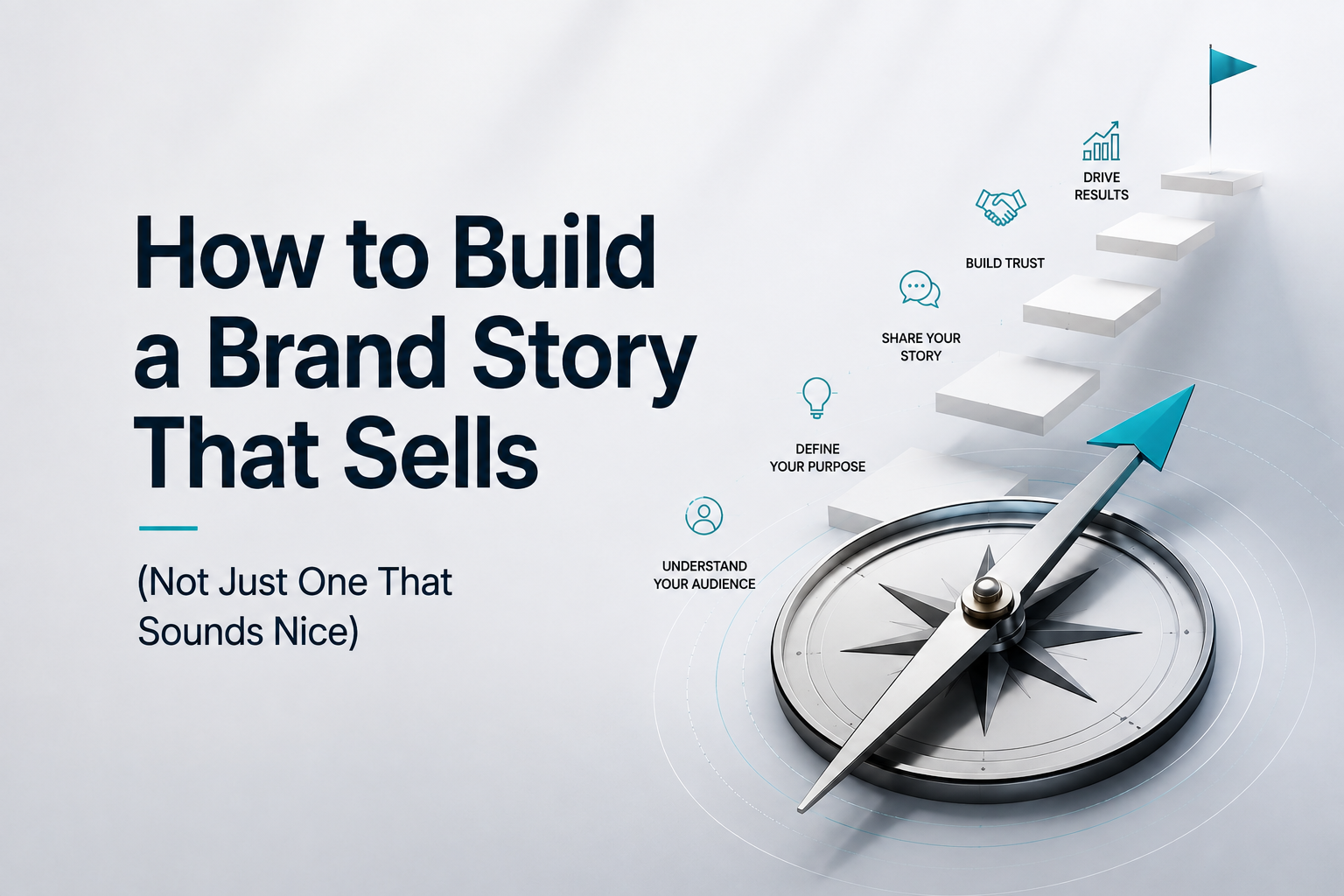
Define your purpose.
Understand your audience.
Make the customer the hero.
Communicate transformation.
Maintain a consistent brand voice.
Reinforce the story across every touchpoint.
Before moving to the next section, ask yourself this question:
If someone removed your company name from your website, would visitors still recognize your brand from the story you’re telling?
If the answer is no, there’s an opportunity to strengthen your narrative.
In an era where consumers are exposed to thousands of marketing messages every day, authenticity has become one of the biggest differentiators.
Customers can quickly tell when a brand is trying too hard to appear relatable or when its messaging doesn’t match reality.
Authentic brand storytelling isn’t about creating a perfect image. It’s about communicating honestly, consistently, and with purpose.
What Makes Brand Storytelling Authentic?
Authentic stories are built on real experiences—not manufactured narratives.
That could include:
The problem that inspired your business.
Challenges your company has overcome.
Customer success stories.
Behind-the-scenes moments.
Employee experiences.
Lessons learned through failures.
Community initiatives that genuinely reflect your values.
Authenticity also means acknowledging imperfections.
Brands that communicate transparently often appear more credible than those trying to project an unrealistic image of perfection.
Walk the Talk
The quickest way to lose trust is to tell a story your business doesn’t live.
For example:
A company promoting sustainability while using excessive plastic packaging.
A people-first employer with poor employee reviews.
A customer-centric business that’s difficult to contact after a sale.
Your actions should reinforce your narrative at every touchpoint.
When your purpose, customer experience, and communication align, your story becomes believable.
Customer Stories Are Often More Powerful Than Founder Stories
Many brands focus heavily on their founders.
While founder stories can build credibility, they shouldn’t dominate your messaging.
Your biggest success stories are often your customers’.
Highlight:
Case studies
Testimonials
User-generated content
Customer transformation stories
Before-and-after results
When prospects see people like themselves succeeding, they’re more likely to trust your brand.
Remember, customers want to imagine themselves in the story—and that only happens when they’re the main character.
B2B Brand Storytelling vs B2C Brand Storytelling
One of the biggest misconceptions about storytelling is that it only works for consumer brands.
In reality, B2B brand storytelling is just as important—it’s simply executed differently.
Business buyers may evaluate ROI, pricing, and implementation, but they’re still people making decisions based on trust, confidence, and perceived risk.
The story remains emotional. The context changes.
B2B Brand Storytelling
B2C Brand Storytelling
Focuses on solving business challenges
Focuses on improving personal experiences
Builds credibility through expertise and proof
Builds emotional affinity and lifestyle appeal
Decision involves multiple stakeholders
Decision is often individual or family-driven
Uses case studies, thought leadership, research, and industry insights
Uses lifestyle content, influencers, communities, and experiences
Longer buying cycle
Shorter buying cycle
Success is measured through business outcomes
Success is measured through personal transformation or satisfaction
What Works Well for B2B Brands?
B2B storytelling should answer questions like:
Why should businesses trust you?
What business challenge do you solve?
How have similar companies succeeded?
What measurable impact do you create?
Instead of relying on product features, build stories around customer outcomes.
For example, rather than saying: “Our CRM has AI-powered automation”, tell the story of how a sales team reduced manual work by 40%, closed deals faster, and improved customer relationships after implementing your solution.
The transformation is far more compelling than the feature.
What Works Well for B2C Brands?
B2C storytelling often appeals to identity, aspirations, and everyday experiences.
Customers aren’t just buying products.
They’re buying confidence, comfort, convenience, belonging, or self-expression.
Whether you’re selling apparel, skincare, home décor, or travel experiences, your story should help customers visualize how their lives improve after choosing your brand.
The principle remains the same for both B2B and B2C:
People remember stories about people, not companies.
Common Brand Storytelling Mistakes to Avoid
A compelling brand story isn’t just about what you say—it’s about how consistently and authentically you communicate it. Even strong brands can weaken their message by making a few common mistakes. Here’s what to avoid.
1. Making Your Brand the Hero
One of the biggest storytelling mistakes is making the narrative all about your company. Customers are more interested in how you can solve their challenges than in your achievements.
Position your audience as the hero and your brand as the trusted guide that helps them succeed.
2. Focusing on Features Instead of Outcomes
Listing product features or service offerings rarely creates an emotional connection. Instead, show the transformation your customers can expect.
People remember the impact your brand creates, not the specifications you provide.
3. Trying to Appeal to Everyone
When your messaging tries to speak to everyone, it often resonates with no one. Define your ideal audience, understand their pain points, and craft a story that reflects their goals and aspirations. The more relevant your story feels, the stronger the connection.
4. Inconsistent Brand Messaging
Your brand story should remain consistent across every touchpoint—from your website and social media to sales presentations and customer support.
While the format may change, the core message and values should always remain the same to build trust and recognition.
5. Being Inauthentic
Customers can quickly spot exaggerated claims or stories that don’t match reality. Authentic storytelling comes from genuine values, real customer experiences, and actions that support your brand promise.
The most memorable brands don’t just tell a story, they live it.
6. Treating Storytelling as a One-Time Exercise
Your brand story should evolve as your business grows. New products, customer insights, market shifts, and success stories all add new chapters to your narrative.
Revisit your messaging regularly to ensure it stays relevant while remaining true to your brand’s purpose.
How to Measure the Success of Your Brand Story
A strong brand story influences awareness, trust, engagement, and eventually revenue. Tracking the right metrics helps you understand whether your messaging is creating meaningful business outcomes.
Brand Awareness Metrics
If your story is resonating, more people will begin recognizing and searching for your brand.
Monitor metrics such as:
Branded search volume
Direct website traffic
Share of voice
Social media mentions
Brand recall surveys
Growing branded searches often indicate that people remember your business—not just the products you sell.
Engagement Metrics
Stories that connect emotionally encourage audiences to spend more time interacting with your brand.
Track:
Average engagement time on blog posts
Scroll depth
Video watch time
Social shares
Comments and discussions
Newsletter sign-ups
High engagement suggests your content is capturing attention rather than being skimmed and forgotten.
Trust and Loyalty Metrics
Since storytelling is ultimately about building relationships, monitor indicators that reflect customer confidence.
These include:
Repeat purchase rate
Customer retention
Referral traffic
Customer reviews
Net Promoter Score (NPS)
Case study inquiries
Positive brand sentiment
Customers who trust your brand are more likely to recommend it to others.
Conversion Metrics
Your story should also contribute to measurable business growth.
Depending on your business goals, monitor:
Lead generation
Demo requests
Contact form submissions
Consultation bookings
Sales qualified leads (SQLs)
Conversion rate improvements
Revenue from organic traffic
For service businesses, stronger storytelling often shortens the sales cycle because prospects already understand your value before speaking with your team.
AI Search Visibility Is Becoming a New Brand Metric
As AI-powered search experiences continue to evolve, businesses should also monitor how frequently their brand is referenced in AI-generated responses.
This includes platforms like ChatGPT, Google AI Overviews, and other AI search assistants.
Brands with strong topical authority, consistent messaging, credible mentions, and well-structured content are more likely to appear in these experiences.
While this metric is still emerging, it will become increasingly valuable as AI influences how people discover and evaluate businesses.
Key takeaway: Don’t measure storytelling by likes alone. Measure whether your story builds trust, attracts qualified leads, increases branded demand, and strengthens long-term customer relationships.
Your Brand Story Is One of Your Most Valuable Business Assets
Every successful brand leaves people with one clear memory. The challenge is that many businesses unintentionally communicate different messages across different touchpoints.
Their website says one thing, their sales pitch says another, and their visual identity tells a completely different story.
This is a pattern the Design Brewery team has seen across many branding projects.
One example is Oncare, a specialized cancer care provider in India. The organization already had a meaningful purpose – making cancer treatment more affordable while delivering patient-centered care. But that story wasn’t consistently reflected across the brand experience.
Rather than jumping straight into a visual redesign, Design Brewery first identified the one idea Oncare should own in people’s minds: patient-centered cancer care, an approach that prioritizes each patient’s needs, preferences, and values throughout their treatment journey.
Building on this insight, Design Brewery developed a robust brand strategy, redefined the brand architecture, and created a cohesive identity system that extended beyond the logo.
Recommendations also included bringing the brand to life across every patient touchpoint from communication materials and interior branding to the overall care experience so that every interaction consistently reflected Oncare’s purpose.
The outcome was more than a refreshed identity.
Oncare gained a clear brand narrative that helped patients, caregivers, and stakeholders immediately understand what the brand stands for and why it’s different.
That’s the real value of brand storytelling. Whether you’re building a new brand or repositioning an existing one, remember these principles:
Start with purpose, not promotions.
Make your customer the hero.
Focus on transformation over features.
Stay authentic in every interaction.
Tell a consistent story across every touchpoint.
Measure your story by the trust and business growth it creates.
Need Help Building a Brand Story That Actually Converts?
At Design Brewery, strategic branding goes beyond designing logos or writing taglines. The team helps businesses uncover what makes them unique and transform that into a compelling brand story that’s consistently reflected across brand strategy, identity, website messaging, and customer experiences.
If your brand has a great offering but struggles to communicate its true value, it’s time to build a story that customers remember and choose.
A new logo, polished website, and carefully selected color palette can make a brand look more professional. But visual appeal alone doesn’t determine whether a brand is memorable, differentiated, or relevant to its audience. This is where many branding projects go wrong. Businesses often start with the visible elements of a brand before...
Brand Storytelling Examples From India: Brands That...
Indian consumers are exposed to thousands of brand messages every day. A strong product can attract attention, but a strong story can give people a reason to remember the brand. This is where brand storytelling becomes valuable. It helps businesses connect their products or services with ideas, emotions, experiences, and cultural moments...
Insights from Independence USA: The Importance of...
Building a Strong Brand Identity: The Foundation of Success In today’s hyper-competitive business landscape, the significance of brand building cannot be overstated. A robust brand identity serves as the cornerstone of a company’s success, distinguishing it from competitors and fostering customer loyalty. According to a study conducted by Independence USA,...