A new logo, polished website, and carefully selected color palette can make a brand look more professional. But visual appeal alone doesn’t determine whether a brand is memorable, differentiated, or relevant to its audience.
This is where many branding projects go wrong. Businesses often start with the visible elements of a brand before defining the strategic foundation behind them. The result can be an identity that looks good but fails to communicate what makes the business different.
Understanding brand strategy vs brand identity helps clarify where each fits into the branding process.
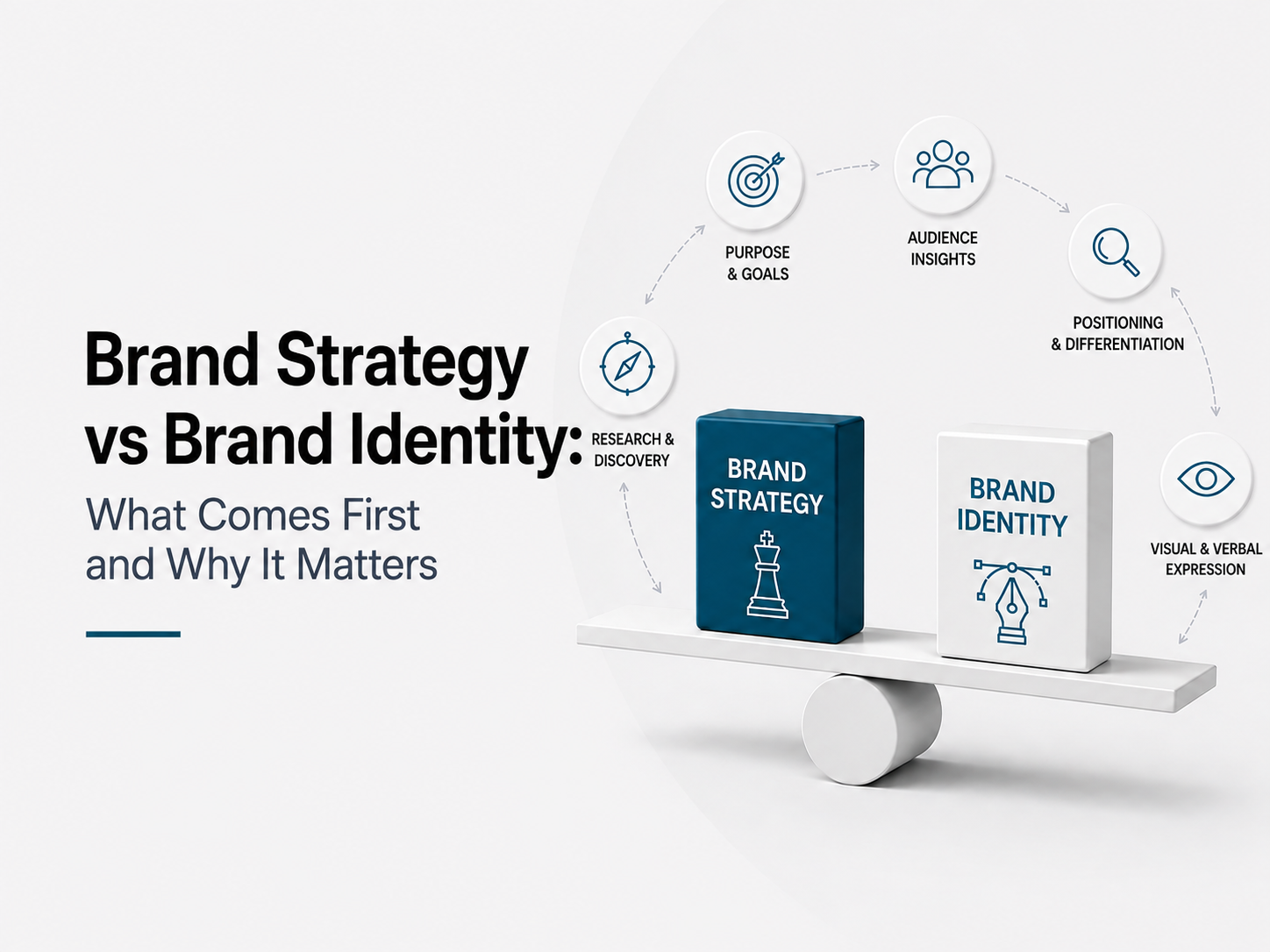
Brand strategy defines the thinking behind the brand—its positioning, audience, purpose, value proposition, personality, and differentiation. Brand identity translates that thinking into a recognizable visual and verbal system through elements such as the logo, colors, typography, imagery, and tone of voice.
At Design Brewery, this distinction is central to how branding projects are approached: a visual identity cannot fix unclear positioning. Before deciding how a brand should look, businesses need to establish what it should stand for and what they want customers to remember.
A simple way to think about it is:
Brand strategy defines what the brand means. Brand identity makes that meaning visible and recognizable.
This article explains the difference between the two, how they work together, what happens when identity comes before strategy, and how businesses can determine what they need.
What Is Brand Strategy?
Brand strategy is the strategic foundation that defines what a brand stands for, who it serves, how it is positioned, and why customers should choose it.
It goes beyond a tagline or a brand mission statement. A well-defined strategy brings together several decisions that shape how the business should be perceived in the market:
- Target audience: Who are you trying to attract and what matters to them?
- Positioning: What space should your brand own in the customer’s mind?
- Value proposition: What specific value do you offer?
- Differentiation: Why should customers choose you over alternatives?
- Brand purpose: Why does the brand exist beyond selling its products or services?
- Brand personality: How should the brand communicate and behave?
Brand promise: What consistent expectation should customers have from every interaction?
These decisions create a strategic direction for everything that follows—from messaging and content to visual identity, website design, marketing campaigns, and customer experience.
For example, consider two financial technology companies offering broadly similar products. One may position itself around speed and simplicity, while another may build its proposition around security and reliability. The products may overlap, but their brand strategies would lead to very different messaging, experiences, and visual identities.
That is why brand strategy should be treated as a business decision, not simply a marketing exercise. It provides the clarity needed to make consistent branding and communication decisions as the company grows.
What Is Brand Identity?
Brand identity is the visible and recognizable expression of a brand’s strategy. It gives the strategic ideas behind a brand a consistent visual and verbal form.
A brand identity typically includes:
- Logo and logo system
- Brand colors
- Typography
- Photography and illustration style
- Graphic elements and visual language
- Iconography
- Tone of voice and messaging principles
- Layout and design principles
- Brand guidelines
However, brand identity is much broader than designing a logo.
A strong identity creates a consistent way for people to recognize and experience the brand across its website, social media, packaging, presentations, advertising, physical spaces, and other customer touchpoints.
For instance, if a brand’s strategy is built around approachability and simplicity, its identity might use straightforward language, accessible typography, uncomplicated layouts, and a warm visual style. If the same business positions itself as highly technical and enterprise-focused, the identity may need to communicate greater precision, authority, and sophistication.
The identity therefore acts as the expression layer of the brand. It takes strategic decisions that can otherwise feel abstract and turns them into tangible cues that customers can recognize.
This is also why brand identity needs consistency. When the same strategic idea is expressed across multiple touchpoints, the brand becomes easier to recognize and remember.
Brand Strategy vs Brand Identity: What’s the Difference?
The simplest distinction is:
Brand strategy defines the direction. Brand identity defines the expression.
They serve different purposes, but they are closely connected.
| Brand Strategy |
Brand Identity |
| Defines what the brand stands for |
Expresses what the brand stands for |
| Focuses on positioning and differentiation |
Focuses on visual and verbal expression |
| Answers “Why should customers choose us?” |
Answers “How should the brand look, sound and feel?” |
| Defines audience, positioning, promise and personality |
Defines logo, colors, typography, imagery and design language |
| Creates strategic clarity |
Creates recognition and consistency |
| Guides branding and marketing decisions |
Applies the strategy across customer touchpoints |
The relationship can be thought of as a sequence:
Business goals → Brand strategy → Positioning → Messaging → Brand identity → Brand experience
If the strategy is unclear, the identity has no strong direction to follow. If the identity is poorly executed, even a strong strategy can struggle to become recognizable in the market.
How Brand Strategy and Brand Identity Work Together
Brand strategy and brand identity are not competing parts of branding. They are two connected layers of the same process.
A strong brand strategy establishes the direction, while the brand identity translates that direction into something customers can see, hear, and experience.
The process typically moves through:
Business goals → Audience → Positioning → Brand Promise → Messaging → Visual Identity → Brand Experience
For example, imagine a healthcare brand whose strategic positioning is built around accessible, patient-centered care. Its identity should reinforce those qualities through approachable communication, reassuring visual cues, clear information, and a consistent experience across its website, physical spaces, and patient communications.
The same principle applies to B2B brands. If a technology company wants to be perceived as an innovative but dependable enterprise partner, its identity needs to balance innovation with credibility rather than relying on visual trends alone.
This alignment matters because customers experience a brand through multiple touchpoints. A compelling website cannot compensate for confusing messaging, just as a strong logo cannot compensate for an unclear value proposition.
When strategy and identity work together, every touchpoint reinforces the same underlying idea.
What Happens When You Design the Identity Before Defining the Strategy?
Starting with the logo or visual identity may seem efficient, especially when a business needs a new website or marketing materials quickly. But without strategic clarity, design decisions often become subjective.
The team may spend weeks debating colours, fonts, layouts, or logo concepts without agreeing on what the brand should communicate in the first place.
This can create several problems.
The Brand Starts Looking Like Its Competitors
Without clear positioning, designers often rely on category conventions. A B2B technology company may end up with the same blue palette, geometric typography, abstract illustrations, and messaging as dozens of competitors.
The identity may look polished, but it doesn’t create meaningful differentiation.
Design Decisions Become Personal Preferences
Without a strategic rationale, feedback tends to become subjective:
“I don’t like this colour.”
“Can we make the logo more modern?”
“This font doesn’t feel premium.”
A defined strategy gives these conversations a more useful foundation. Instead of asking whether something looks good, the team can ask whether it supports the intended brand perception.
Messaging and Design Start Telling Different Stories
A brand may position itself as approachable and customer-focused but communicate through highly technical language and an overly corporate visual identity.
When verbal and visual signals contradict each other, customers receive a fragmented impression of the brand.
The Identity Becomes Difficult to Scale
A logo alone cannot provide enough direction for a growing brand. As new websites, social channels, campaigns, presentations, packaging, or physical environments are created, teams need clear principles for how the brand should look and communicate.
A strategic foundation makes it easier to build an identity system that can scale across these touchpoints.
Revisions Keep Increasing
When the strategic direction hasn’t been agreed upon, design revisions often become a way of trying to discover the strategy indirectly.
That makes the process longer, more expensive, and less effective.
The key takeaway: design should not be asked to answer strategic questions that haven’t been resolved. Strategy provides the criteria against which identity can be evaluated.
A Simple Example: The Same Business Can Need Two Very Different Brand Identities
Consider a fintech company offering a digital payments platform.
The business could choose to position itself around speed and innovation, targeting digitally mature businesses that want faster, simpler payment experiences.
Or it could position itself around security and reliability, targeting established enterprises that prioritise risk management and dependable infrastructure.
The product may be similar. The strategic direction is not.
- A speed-and-innovation positioning could lead to:
- More energetic visual language
- Contemporary typography
- Direct, concise messaging
- Product-led communication
- Strong emphasis on speed and simplicity
A security-and-reliability positioning could require:
- More reassuring visual cues
- Authority-driven messaging
- Greater emphasis on credentials and proof
- Detailed product information
- Strong trust and security signals
Neither identity is inherently better. The right identity depends on what the brand is trying to own in the customer’s mind.
This is why brand identity design should begin with strategic clarity. When the positioning is clear, design has a purpose beyond aesthetics—it becomes a tool for communicating and reinforcing the brand’s intended perception.
When Does Your Business Need Brand Strategy?
Brand strategy becomes particularly important when a business is entering a new stage of growth or when its existing positioning no longer reflects where the business is headed.
You may need to revisit your brand strategy when:
- Launching a new brand: You need to define your audience, positioning and differentiation before investing heavily in identity and marketing.
- Entering a new market: A positioning that works in one geography or category may not translate effectively to another.
- Targeting a new audience: Changes in customer segments often require a different value proposition or communication approach.
- Expanding your product or service portfolio: A clear strategy helps determine whether new offerings fit the existing brand or require a broader brand architecture.
- Competing in a commoditized category: When products or services appear increasingly similar, stronger positioning can create meaningful differentiation.
- Experiencing inconsistent communication: If different teams, channels or agencies describe the brand differently, strategic clarity may be missing.
- Preparing for significant growth or rebranding: A stronger strategic foundation can ensure that the new identity supports the company’s next stage rather than simply updating its appearance.
The key question isn’t whether your business needs a brand strategy because every business technically has one. The question is whether that strategy is intentional, differentiated and aligned with where the business wants to go.
When Does Your Business Need a Brand Identity?
A business can have a strong brand strategy and still need a new or improved identity if its current visual and verbal expression no longer communicates that strategy effectively.
Common triggers include:
Launching a New Brand
A new business needs more than a logo. A defined identity creates the visual and verbal system required to communicate consistently from launch.
Outgrowing an Existing Identity
As businesses evolve, an identity created during the early stages may start to feel outdated, limiting, or disconnected from the company’s current audience and positioning.
Repositioning the Brand
If the business has changed how it wants to be perceived, the existing identity may need to evolve to reflect that new direction.
Expanding Across Channels
An identity that works for a website may not translate effectively to social media, packaging, presentations, advertising, physical spaces, or digital products. A scalable identity system provides consistency across these environments.
Becoming More Consistent
Sometimes the problem isn’t that the identity is fundamentally wrong. Different teams may simply be using different logos, colours, fonts, imagery, or messaging. In that case, stronger guidelines and a more structured identity system may be more appropriate than a complete rebrand.
This distinction is important because not every branding problem requires a new logo. Sometimes the business needs a clearer strategy. Sometimes it needs a stronger identity system. And sometimes it needs better implementation of an identity it already has.
The Design Brewery Perspective: Strategy Before Aesthetics
The Design Brewery team has observed a recurring pattern across branding projects: businesses often approach branding as a visual problem when the underlying challenge is strategic clarity.
A company may ask for a new logo because its brand “doesn’t feel premium enough.” A website may need a redesign because it “looks outdated.” Or a marketing team may want new campaign creatives because the existing communication “isn’t connecting.”
But these symptoms don’t always point to a design problem.
Before changing the visual language, it is worth asking:
What should the brand be known for? Who is it trying to influence? And what should people remember after interacting with it?
Design Brewery approaches this through a simple progression:
Strategy → Story → Identity → Experience
Strategy defines the brand’s positioning and differentiation.
Story turns that strategic direction into a clear narrative and messaging system.
Identity gives the story a recognizable visual and verbal expression.
Experience ensures that the promise is reinforced across the customer journey.
This approach also makes design decisions easier to evaluate. Instead of asking whether a particular colour, typeface, or layout looks attractive in isolation, the more useful question becomes: Does this choice strengthen the perception the brand is trying to create?
That is where strategic branding moves beyond aesthetics. Design is no longer simply making a business look better; it becomes a tool for making the brand clearer, more distinctive, and more consistent.
How to Know If Your Brand Needs Strategy, Identity or Both
Not every branding challenge requires a complete rebrand. Before investing in a new identity, it helps to identify whether the underlying problem is strategic, visual, or both.
Use these questions as a quick diagnostic:
| Question |
If the answer is “No” |
| Can you clearly explain who your ideal customer is? |
You may need stronger brand strategy. |
| Can you explain why customers should choose you over competitors? |
Your positioning may need work. |
| Does your team communicate the same brand promise consistently? |
Your messaging strategy may need clarification. |
| Does your current visual identity reflect your desired positioning? |
Your brand identity may need to evolve. |
| Does your identity work consistently across digital and offline touchpoints? |
You may need a stronger identity system. |
| Has the business evolved significantly since the identity was created? |
Consider a brand refresh or rebrand. |
If the first three answers are unclear, redesigning the visual identity is unlikely to solve the underlying problem.
If the strategy is clear but the identity feels outdated, inconsistent, or disconnected from the intended positioning, the business may need an identity redesign without completely redefining the brand.
In many cases, however, strategy and identity need to evolve together—particularly when a business is entering a new market, changing its positioning, or moving into a new stage of growth.
From Strategy to Identity: What Does a Complete Branding Process Look Like?
A strong branding process doesn’t begin with choosing fonts or sketching logos. It starts by understanding the business and establishing the strategic decisions that the identity needs to express.
A typical process can follow these stages:
-
Discovery and Business Understanding
Start with the business itself—its objectives, customers, competitors, strengths, challenges, and future direction.
The goal is to understand the context in which the brand needs to compete.
-
Audience and Market Understanding
Identify the audiences that matter most and understand their needs, expectations, motivations, and perceptions of the category.
Competitive analysis is equally important because differentiation cannot be defined in isolation.
-
Positioning and Differentiation
Define where the brand should sit in the market and what makes it meaningfully different.
This is where the brand’s value proposition, competitive advantage, and positioning begin to take shape.
-
Brand Promise and Personality
Establish what customers should consistently expect from the brand and determine how the brand should communicate.
Is it authoritative? Approachable? Progressive? Dependable? The answer influences both verbal and visual expression.
-
Messaging and Brand Story
Translate the strategic direction into a clear messaging hierarchy and narrative.
This gives the organisation a consistent way to communicate its value across websites, campaigns, sales materials, social media, and other channels.
-
Visual Identity
Only now does the visual identity take shape.
Logo, typography, colours, imagery, graphic elements, layouts, and other visual assets should all reinforce the strategic direction established earlier.
-
Brand Guidelines and Implementation
Finally, document how the identity should be used and apply it consistently across relevant touchpoints.
This might include the website, social media, presentations, packaging, advertising, physical spaces, internal communications, and customer experience.
The process can be summarised simply:
Understand → Position → Define → Express → Implement
The exact process may vary by business, but the principle remains consistent: the identity should be an outcome of strategic decisions, not a substitute for them.
Key Takeaways
The distinction between brand strategy and brand identity becomes much clearer when you look at the role each plays:
- Brand strategy defines the direction — positioning, audience, differentiation, promise, and personality.
- Brand identity expresses that direction — logo, colours, typography, imagery, messaging, and visual language.
- Strategy should guide identity, not the other way around.
- A strong identity cannot compensate for unclear positioning or inconsistent messaging.
- Not every branding challenge requires a complete rebrand. Sometimes the issue is strategic clarity, while other times the identity simply needs to evolve.
- The strongest brands connect strategy, story, identity, and customer experience into one consistent system.
Ultimately, branding isn’t about choosing between strategy and identity. It’s about making sure the two are working toward the same perception in the minds of your customers.
Need help building a brand that is strategically clear and visually distinctive?
Design Brewery helps businesses develop brand strategies and identities that connect positioning, messaging, design, and customer experience. If your current brand feels inconsistent, difficult to differentiate, or no longer reflects where the business is headed, start with the strategy.