Fintech has made financial services faster, more accessible and increasingly digital. As competition grows across payments, lending, investments, wealth management and financial infrastructure, product experience is becoming an important differentiator.
Users now expect financial products to be as intuitive as the digital products they use every day. Complex financial information, multiple workflows and high-stakes decisions need to be presented with clarity and simplicity.
At the same time, AI, personalization and automation are changing how users interact with financial products. These technologies can create more helpful experiences, but they also bring new expectations around transparency, security and user control.
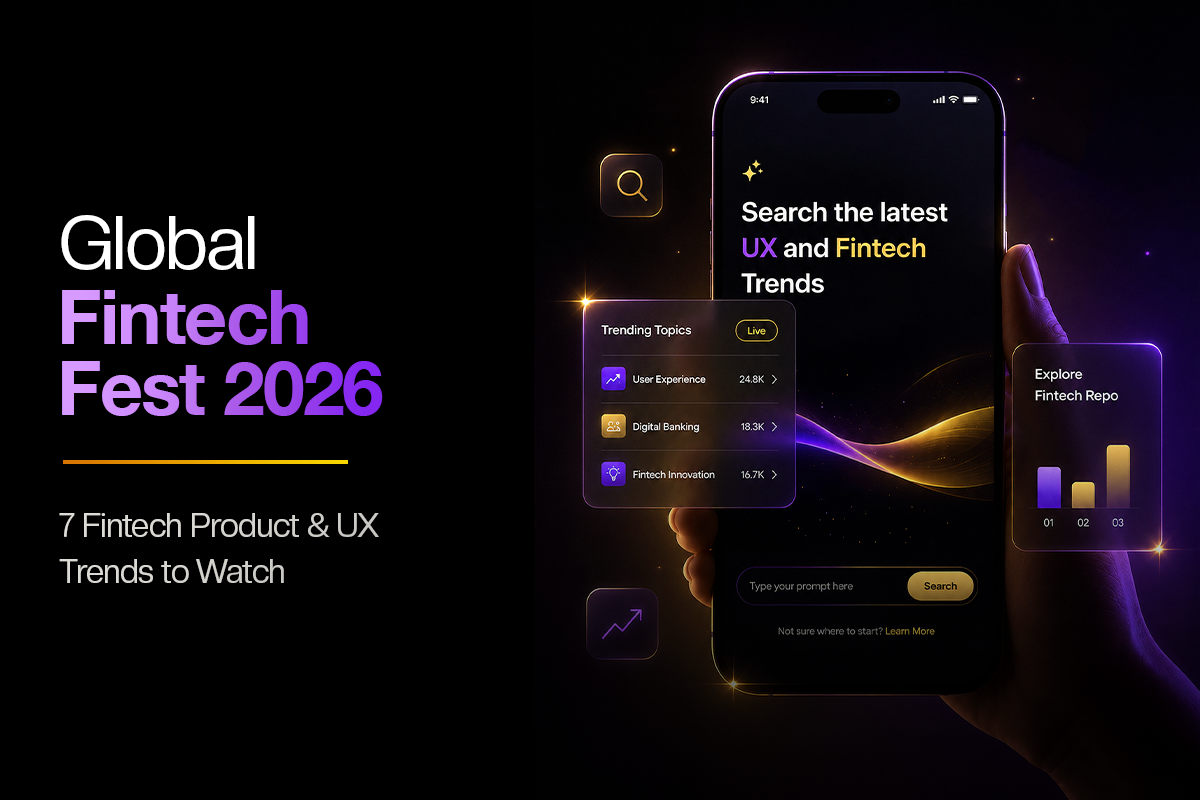
With Global Fintech Fest 2026 bringing fintech and technology leaders together in Mumbai from September 8–11, these shifts will be central to conversations about the future of financial products. Here are seven fintech product and UX trends worth watching.
1. Agentic AI Will Move From Feature to Financial Workflow
AI in fintech is moving beyond chatbots and basic recommendations. With Agentic AI emerging as a key theme at GFF 2026, financial products are likely to explore AI that can understand context, recommend actions and assist users across multi-step workflows.
For example, an investment platform could help users analyse their portfolio and suggest actions, while a lending platform could guide applicants through documentation or eligibility processes.
This shift changes the role of fintech UX design. AI-powered workflows need to clearly communicate what the system is doing, why it is making a recommendation and when the user needs to make a decision. Transparency, user control and easy intervention will become important parts of the experience.
The opportunity is to make AI feel like a useful part of the financial journey rather than another feature added to the interface.
2. Financial Products Will Need More Human-Centered UX
Financial products often involve complex information, unfamiliar terminology and decisions with real financial consequences. As fintech expands into more sophisticated services, simplifying this complexity will become increasingly important.
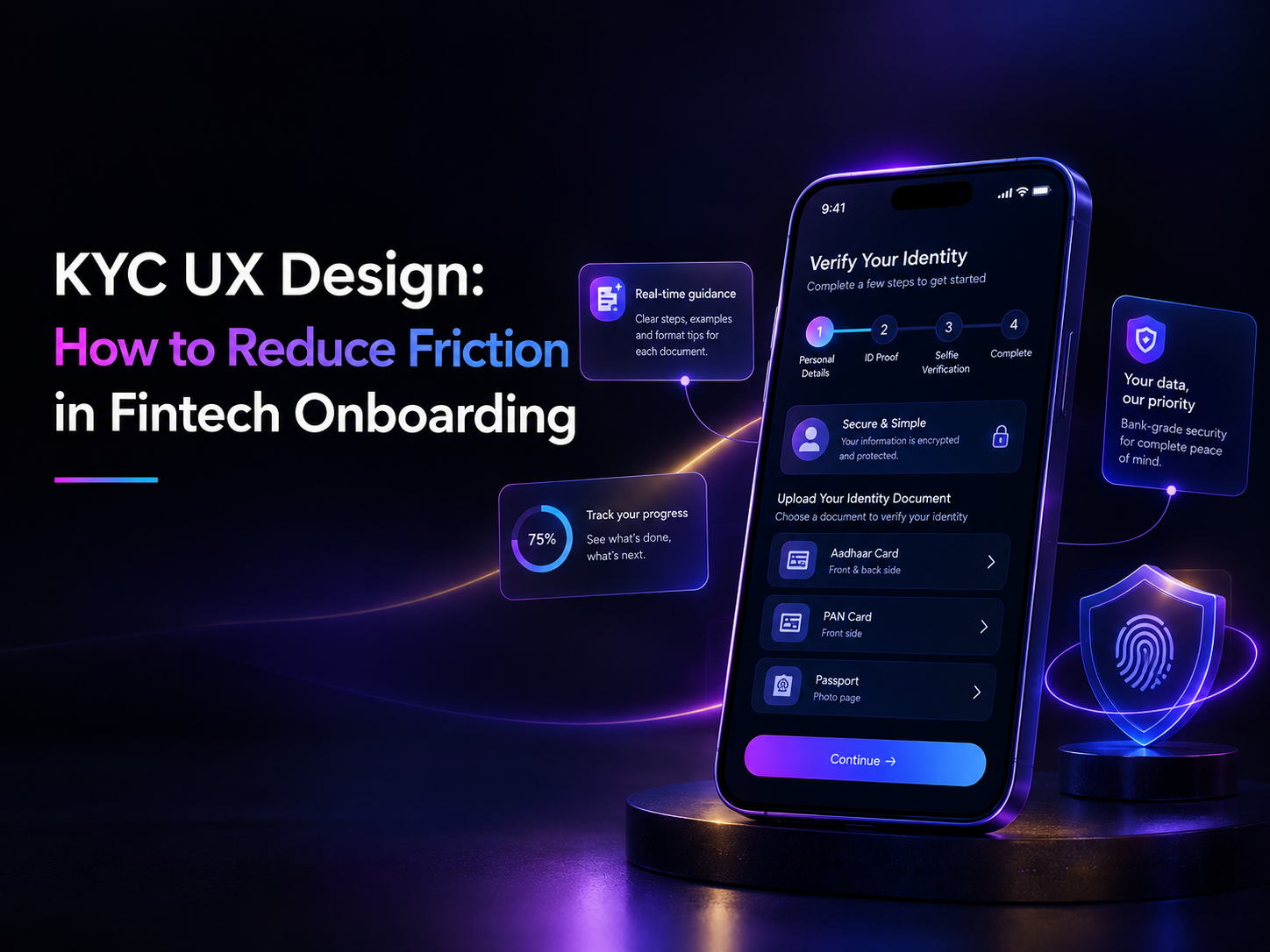
A well-designed experience can help users understand what they need to do, why it matters and what happens next. This applies across onboarding and KYC, investment decisions, loan applications, payments, insurance and wealth management.
Human-centered fintech product design means understanding different user needs and designing around their context. A first-time investor may need more guidance, while an experienced investor may prioritize speed and access to detailed data.
The goal is to create interfaces that provide the right level of information and guidance without overwhelming users, making complex financial journeys easier to navigate.
3. Trust Will Become a Core UX Differentiator
Trust has always been important in financial services, but digital products have made every interaction part of the trust-building experience.
Users need confidence when entering personal information, completing KYC, making payments, viewing financial data or acting on an investment recommendation. Small details such as clear security messaging, transparent fees, understandable disclosures and predictable transaction states can influence that confidence.
AI-powered financial products add another layer. When a system makes a recommendation or performs an action, users need to understand what happened, why it happened and what control they have.
For fintech teams, trust therefore needs to be designed into the product through clarity, transparency, security cues and consistent interactions, rather than treated only as a branding or compliance requirement.
4. Fintech Dashboards Will Evolve From Data Displays to Decision Interfaces
Financial dashboards have traditionally focused on displaying information such as account balances, transactions, holdings, and performance. As fintech products become more sophisticated, dashboards will increasingly need to help users understand that information and decide what to do next.
This means prioritizing the most relevant information instead of presenting every available metric at once. Clear data visualization, contextual insights, and actionable prompts can help users quickly identify important changes or opportunities.
For example, an investment dashboard could highlight portfolio performance, significant changes in asset allocation, and relevant actions instead of simply displaying a long list of holdings.
Effective fintech UI design will therefore focus on prioritization, personalization, and cognitive simplicity. The dashboard should answer key user questions quickly while allowing deeper exploration when needed.
5. Personalization Will Go Beyond Recommendations
Personalization in fintech has often meant product recommendations, investment suggestions, or targeted offers. The next stage will involve adapting the entire experience to the user’s context and financial journey.
A first-time investor may need educational guidance and simplified information, while an experienced investor may prefer detailed data and faster access to advanced features. Similarly, the needs of a borrower during an application are different from those of an existing customer managing repayments.
Fintech products can use user behavior, goals, lifecycle stage and preferences to make experiences more relevant, from the information shown on the dashboard to the guidance provided during key workflows.
The challenge for financial app design is finding the right balance. Personalization should make the experience more useful without making it unpredictable, intrusive, or difficult to understand.
6. Design Systems Will Become Critical as Fintech Products Scale
Fintech products are constantly evolving, with new features, financial products, user segments, and digital channels being added over time. Without a structured design foundation, this growth can lead to inconsistent interfaces and fragmented user experience.
A fintech design system creates reusable components, interaction patterns, and guidelines that help teams maintain consistency while designing and launching new features. It also improves collaboration between design and development teams, making implementation more efficient.
For products spanning web and mobile, a shared design system becomes even more valuable. Teams can maintain consistent navigation, forms, dashboards, alerts, and other critical interactions while adapting them to different platforms.
Scalable fintech product design therefore needs to consider not only how an experience works today, but also how easily it can evolve as the product and business grow.
7. Fintech Brands Will Need to Connect Product Experience With Brand Experience
For financial products, the relationship between brand and product is becoming increasingly important. A brand may communicate trust, simplicity or innovation, but users ultimately experience those promises through the website, app and everyday interactions.
A premium brand paired with a confusing onboarding flow can create a disconnect. Similarly, a well-designed app can lose credibility if the website or communication feels inconsistent.
Fintech companies therefore need a connected experience across branding, website, product UI and customer communication. Visual language, tone of voice, information hierarchy, and interaction patterns should work together to create a consistent identity.
This is particularly important in crowded fintech categories where products can offer similar functionality. A cohesive brand and product experience can help companies build recognition, credibility, and stronger relationships with users.
What These Trends Mean for Fintech Product Teams
These trends point to a broader shift in how financial products need to be designed. Product teams need to consider technology, user experience, trust and scalability together rather than treating UX as a final layer of the product.
A practical starting point is to evaluate:
- Audit critical user journeys across onboarding, KYC, transactions, dashboards and support to identify friction.
- Identify meaningful AI opportunities where automation or intelligence can genuinely improve the financial experience.
- Review information hierarchy to ensure users can understand important financial data and actions quickly.
- Strengthen trust signals through transparent communication, security cues, clear disclosures and predictable interactions.
- Evaluate personalization based on user needs, behaviour and lifecycle rather than simply adding recommendations.
- Assess the design system to ensure it can support new features, products and platforms as the business grows.
- Connect brand and product experience so the same principles of trust, clarity and differentiation carry across every digital touchpoint.
For fintech companies preparing for their next stage of growth, these areas can reveal opportunities to improve both customer experience and product performance.
How Design Brewery Approaches Fintech Product & UX Design
At Design Brewery, we approach fintech design as a product and business challenge, not simply a UI exercise. Financial products need to balance usability with complex information, trust, scalability and business objectives.
Our process typically begins by understanding the existing product, users and competitive landscape. A product audit and UX evaluation helps identify friction across key journeys and creates a clear foundation for redesign.
From there, we work across:
- Product strategy and UX research to understand users, business goals and product opportunities
- UX and product redesign to simplify complex financial journeys
- Fintech UI/UX design for intuitive and scalable interfaces across web and mobile
- Design systems that support consistent experiences as products grow
- AI × UX to identify and design meaningful AI-powered experiences
- Brand and digital experience to create consistency from the first website interaction through the product
Case Study : Wealthy Nivesh
Our work with Wealthy Nivesh brought these capabilities together across brand strategy, identity, website design and a comprehensive web and mobile product redesign.
We began with a detailed product audit and heuristic evaluation, followed by competitor analysis and user-flow assessment. The redesigned platform introduced a modular, card-based design system, simplified complex financial information and created a scalable architecture capable of supporting future asset classes.
The result was a more intuitive wealth management experience that could serve both digitally comfortable investors and traditional wealth holders while supporting Wealthy Nivesh’s growth.
This reflects our approach to fintech product design: understand the complexity, identify the friction and build an experience that makes the product easier to use and easier to scale.
Meet Design Brewery Team at Global Fintech Fest 2026
GFF 2026 is an opportunity to move beyond conversations about technology and discuss how financial products actually work for the people using them.
Design Brewery team will be in Mumbai from September 8–11, 2026, connecting with founders and senior product, growth, CX and technology leaders across fintech, BFSI, financial infrastructure and SaaS.
If you’re:
- Building or redesigning a fintech product
- Improving onboarding, KYC or conversion journeys
- Simplifying complex financial experiences
- Exploring AI-powered product experiences
- Scaling a product across platforms or features
- Looking to strengthen your fintech brand and digital presence
we’d be happy to discuss your challenges and explore where design can create meaningful impact.
Meet Design Brewery at GFF 2026 →
Connect with our Founder, Prashasti
Email : prashasti@designbrewery.in
LinkedIn : https://www.linkedin.com/in/prashasti-ranjan/
Visit Website : Fintech Design Agency in India | UI/UX, Branding & Marketing – Design Brewery
Whether you’re looking at a specific UX challenge or thinking about a larger product transformation, let’s connect in Mumbai and talk about what you’re building.