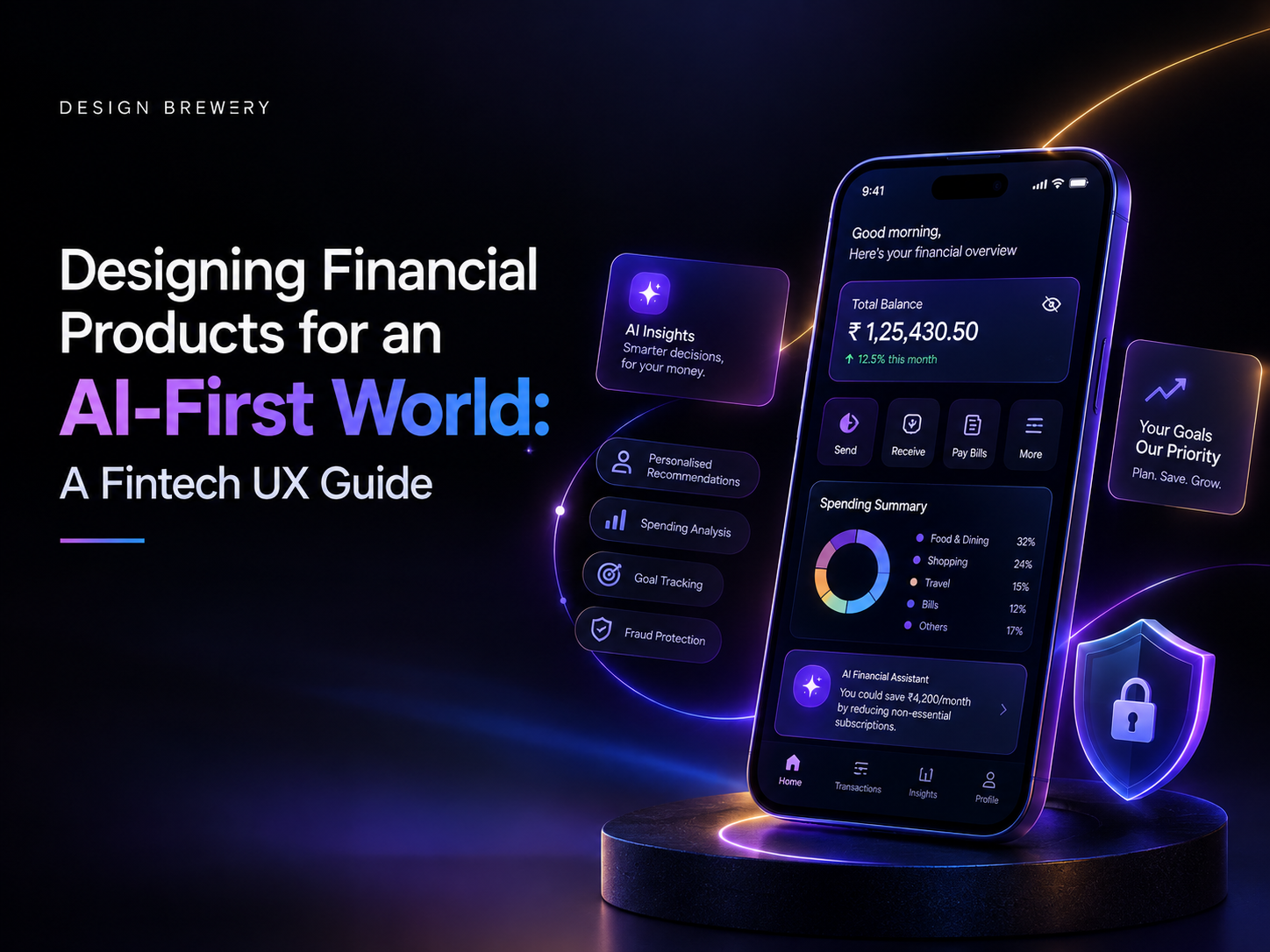
For years, financial products have focused on making banking and financial services easier to access digitally. Mobile apps replaced branch visits, dashboards replaced paper statements, and self-service journeys reduced the need for customer support.
AI is changing what users expect from these products.
A modern financial product can interpret financial data, understand user intent, identify patterns, and provide relevant guidance. Instead of simply showing a user their balance or spending history, it can help them understand what the information means and what they could do next.
This shift is already influencing consumer expectations. Plaid’s 2026 State of Intelligent Finance report found that 55% of people surveyed had used AI for money-related tasks in the previous 12 months, while 86% of AI users said it helped them better understand their money.
For fintech companies, this creates a product-design opportunity. AI can change how users discover information, make financial decisions, and complete tasks.
The challenge for product teams is deciding where intelligence genuinely improves the financial experience and designing the interaction around it.
What Does AI-First Mean in Fintech?
AI-first fintech refers to financial products where artificial intelligence is considered part of the product experience and architecture from the beginning.
It goes beyond adding an AI chatbot or recommendation feature to an existing application. The product is designed around what AI makes possible: understanding context, personalising information, anticipating needs and assisting users with complex financial tasks.
AI as Part of the Product Foundation
Traditional financial products are generally structured around predefined journeys. Users select an account, navigate to a particular feature, enter information and complete an action.
An AI-first product can interpret what the user is trying to accomplish and determine the information or workflow needed to support that goal.
For example, a user might ask:
“Can I afford a ₹50,000 purchase next month?”
A conventional product could require the user to review their balance, upcoming payments, monthly spending and savings separately.
An AI-first experience could bring these signals together and provide a contextual answer, along with the reasoning behind it.
From Financial Tools to Intelligent Experiences
This changes the role of the financial product.
The product can move from displaying information to helping users interpret information and take informed action.
This does not mean every interaction needs an AI interface. Simple tasks can remain simple. AI becomes valuable when the user needs interpretation, personalisation, prediction or assistance with a complex decision.
Intuit’s Intuit Assist provides an example of this direction. The company describes it as a generative AI-powered financial assistant that provides personalised recommendations across products such as TurboTax, Credit Karma and QuickBooks.
The important design shift is that intelligence becomes part of the experience itself.
How AI Changes Fintech UX
AI changes more than the interface layer. It changes how users interact with financial products and how products respond to user needs.
From Navigation to Intent
Traditional fintech experiences often require users to know where a task lives within the product.
AI allows the interaction to begin with intent.
A user can say:
“Show me where I spent the most last month.”
or:
“Help me reduce my monthly expenses.”
The product can interpret the request, identify relevant financial information and present the appropriate response.
This can reduce the cognitive effort involved in navigating complex financial products.
From Reactive to Proactive Experiences
Most financial products respond when users take an action. AI can help products identify relevant events and surface information proactively.
For example, a product could identify:
- A recurring expense that has increased significantly
- An upcoming cash-flow gap
- Spending that may affect a savings goal
- An unusual transaction pattern
- An opportunity to adjust a financial plan
The experience becomes more contextual because the product can respond to what is happening in the user’s financial life.
From Information to Assistance
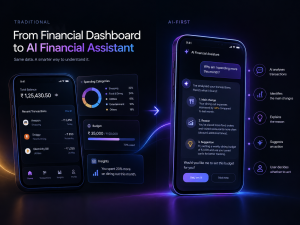
Financial products have traditionally been strong at presenting information. AI creates an opportunity to help users interpret that information.
A spending dashboard might show that restaurant spending increased by 18%.
An intelligent experience can explain what contributed to the increase, connect it with previous spending patterns and suggest an action based on the user’s financial goal.
This distinction is important for fintech UX. The value of AI comes from helping users understand and act on financial information, while keeping the user informed and in control.
Plaid’s 2026 research reflects this shift, highlighting consumer demand for personalised guidance that goes beyond displaying balances and transaction histories.
5 UX Principles for AI-First Fintech Products
AI can make financial products more intelligent, but intelligence alone does not create a good user experience. Financial decisions involve money, privacy and risk, so users need to understand what the product is doing and remain confident about the actions they take.
Five UX principles become particularly important when designing AI-first financial products.
1. Make AI Explainable
An AI recommendation becomes more useful when users understand why it was made.
For example, instead of showing:
You should reduce your spending this month.
The product could explain:
Your discretionary spending is 18% higher than your three-month average, mainly due to dining and travel expenses.
The explanation gives the user context and makes the recommendation easier to evaluate.
This becomes especially important for high-impact financial decisions such as lending, fraud detection and investment recommendations. Explainability helps users understand AI outputs while also supporting accountability and regulatory requirements.
2. Keep Users in Control
AI can recommend or prepare an action, while the user decides whether to proceed.
For example:
AI identifies an upcoming cash-flow gap
→ suggests moving ₹10,000 from savings
→ shows the impact
→ user approves or changes the amount
The interface should make actions, permissions and consequences clear before execution.
This is particularly important as financial products move toward AI agents that can perform tasks on a user’s behalf.
3. Personalise With Context
Personalisation becomes more valuable when AI can consider multiple aspects of a user’s financial situation.
A savings recommendation, for example, can consider:
- Income patterns
- Recurring expenses
- Existing savings
- Financial goals
- Upcoming payments
- Previous behaviour
The experience can then provide guidance that is relevant to the individual’s context.
Personalisation should also remain transparent. Users should know when recommendations are based on their financial data and have appropriate control over how that data is used.
4. Design for Proactive Assistance
AI allows financial products to identify situations that may require attention before the user actively searches for them.
Examples include:
- A recurring payment that has increased
- A potential cash-flow shortfall
- An unusual transaction
- A savings goal that may be missed
- A portfolio change that needs attention
The design challenge is deciding what deserves the user’s attention and when.
Too many notifications can create alert fatigue. Effective proactive UX prioritises information based on relevance, urgency and potential impact.
5. Build Human Escalation Into the Experience
AI should have a clear path to human support when a situation becomes complex, sensitive or high-risk.
A customer dealing with a disputed transaction, loan issue or fraud case may need more than an automated response.
Human escalation should therefore be treated as part of the product journey.
The handoff should preserve relevant context so that users do not have to repeat the entire issue to a support representative. Financial institutions are increasingly emphasising this combination of AI assistance and human oversight as AI adoption expands.
Together, these principles create a useful foundation for AI-first fintech UX:
Explain → Control → Personalise → Assist → Escalate
Designing Trust Into AI-First Financial Products
Trust becomes a product-design requirement when AI starts influencing financial decisions.
Recent research from Deloitte, reported by the ABA Banking Journal in September 2026, found that 72% of bank customers hesitate to share information about their financial situation with generative AI tools. Only 49% said they trusted the accuracy of banking information from generative AI, compared with 79% for bank websites.
This gap shows why fintech companies need to design trust into AI experiences rather than treating it as a communication exercise.
Make AI Decisions Understandable
Users should be able to understand the key factors behind an important recommendation or decision.
The level of explanation can vary by context. A spending recommendation may need a short explanation, while a credit-related decision may require substantially more detail.
Make Important Actions Reviewable
When AI can initiate or prepare a financial action, users should have an opportunity to review it.
A good interface can clearly show:
What will happen → Why it is recommended → What information was used → What the user needs to approve
This creates a clear boundary between AI assistance and user authorisation.
Design for Uncertainty and Errors
AI systems can produce incorrect or incomplete outputs. Financial products need clear states for uncertainty, correction and recovery.
For example, instead of presenting an uncertain prediction as a fact, the product can communicate the confidence level, explain the limitation and provide another way to verify the information.
This is particularly important in finance because an incorrect answer can have a direct financial consequence.
Keep Human Oversight Where Stakes Are High
AI can support financial decisions while human expertise remains responsible for situations requiring judgement, exceptions or intervention.
This principle is already reflected in financial-sector AI guidance, which emphasises transparency, accountability and the ability for humans to intervene or override AI-driven decisions.

Where AI-First UX Can Create the Most Value in Fintech
AI can influence almost every part of a financial product, but its UX value is strongest where users need interpretation, personalisation, prediction or assistance with complex tasks.
Lending and Credit
Loan applications often involve multiple forms, eligibility checks and complex financial information. AI can simplify this journey by helping users understand requirements, identifying missing information and providing contextual guidance during the application.
The experience can also make credit decisions easier to understand by showing relevant factors and explaining what users can do to improve their financial position.
For fintech teams, the opportunity lies in making a traditionally complex journey easier to navigate and understand.
Personal Finance
Personal finance is one of the strongest areas for AI-first experiences because users often have large amounts of financial information but limited time to interpret it.
An AI-powered product could answer questions such as:
“Why did I spend more this month?”
“How much can I save by December?”
“What expenses should I review?”
The UX can bring together transactions, recurring expenses, goals and cash flow to provide a contextual response.
Wealth Management
Investment platforms can use AI to help users understand portfolio performance, market information and potential scenarios.
For example, instead of presenting multiple charts and financial indicators, an AI-assisted experience could summarise portfolio changes and explain which factors contributed to them.
The interface should clearly distinguish between information, recommendation and financial advice, particularly in regulated environments.
Payments and Fraud
AI can also improve everyday payment experiences.
A product can identify unusual transaction patterns, flag potentially fraudulent activity and provide contextual information when a payment requires attention.
The UX challenge is balancing security with convenience. Alerts need enough context for users to understand the issue and take the appropriate action quickly.
The Common Design Opportunity
Across these use cases, the underlying opportunity is similar:
Reduce the effort required to understand financial information and decide what to do next.
That makes AI particularly valuable when a financial task involves multiple data points, personalised decisions or repeated manual steps.
What Existing Financial Products Can Teach Us
The AI-first fintech landscape is evolving quickly, and several financial products offer useful lessons for designers.
Revolut: Personalisation Across the Financial Experience
Revolut has built a broad financial ecosystem where users can manage payments, spending, savings and other financial services within one product experience.
Design lesson: As more financial services come together, personalisation and contextual guidance become increasingly important for helping users navigate the product.
Intuit: Working With Financial Context
Intuit has incorporated generative AI into products through Intuit Assist, which uses financial and business context to provide personalised assistance.
Design lesson: AI becomes more useful when it understands the user’s situation and connects information across the product.
Klarna: Conversational Interaction
Klarna has used AI extensively across customer service and shopping experiences, including conversational interactions.
Design lesson: Natural-language interfaces can simplify complex interactions when users can describe their intent in their own words.
The takeaway for fintech designers is simple: the strongest AI experiences are closely connected to the underlying product, its data and the user’s immediate goal.
How to Approach AI-First Product Design
Designing an AI-first financial product requires collaboration between product, UX, engineering, data, risk and compliance teams.
A practical process can begin with five steps.
Identify the Right User Problem
Find tasks where users currently spend significant time searching, comparing, interpreting or completing repetitive steps.
Map Data, Permissions and Risks
Define what information the AI needs, what it can access and which actions require explicit user approval.
This should happen during product design rather than after the AI experience has been designed.
Design the AI Interaction
Map how users will:
- Express their intent
- Receive an AI response
- Ask follow-up questions
- Review recommendations
- Correct mistakes
- Approve actions
- Exit or escalate the interaction
The interaction model should account for both successful and unsuccessful AI responses.
Build Human Fallbacks
Define where human intervention is required and how the transition happens.
For high-stakes financial decisions, the human fallback should be visible and easy to access.
Test More Than Usability
Traditional usability testing remains important, but AI-first products also need testing around:
- Trust
- Accuracy
- Explainability
- User control
- Perceived risk
- Recovery from incorrect responses
The goal is an experience where AI makes the financial product more useful while users remain informed and confident about the decisions they make.
The Design Brewery Perspective: AI Should Change the Experience
AI-first product design is ultimately an experience-design challenge.
Adding an AI chatbot to an existing fintech application can improve customer support, but it does not necessarily change how the product works. A genuinely AI-first experience considers where intelligence can improve the entire user journey.
This means asking better product questions:
- What does the user actually want to accomplish?
- Which decisions require interpretation?
- What information should the product bring together?
- Which actions can AI assist with?
- Where should the user review and approve an action?
When does experience need human intervention?
The answers can influence everything from information architecture and interaction design to content, workflows and product strategy.
At Design Brewery, we see AI-first fintech design as a combination of product thinking, UX strategy and intelligent interaction design. The objective is to make complex financial experiences easier to understand and easier to act on while maintaining the clarity and control that financial products require.
Designing the Next Generation of Financial Products
AI is changing the capabilities of financial products and, with them, the expectations users have from fintech experiences.
The next generation of products will need to understand context, provide relevant assistance, support better decisions and make AI-driven interactions trustworthy.
For fintech companies, this creates an opportunity to rethink how their products work from the ground up.
Designing an AI-first financial product starts with understanding the user problem, identifying where intelligence creates value and building an experience that keeps users informed and in control.
If you’re building or redesigning a fintech product, Design Brewery can help translate AI capabilities into intuitive financial experiences through fintech UX, product strategy and AI product design.