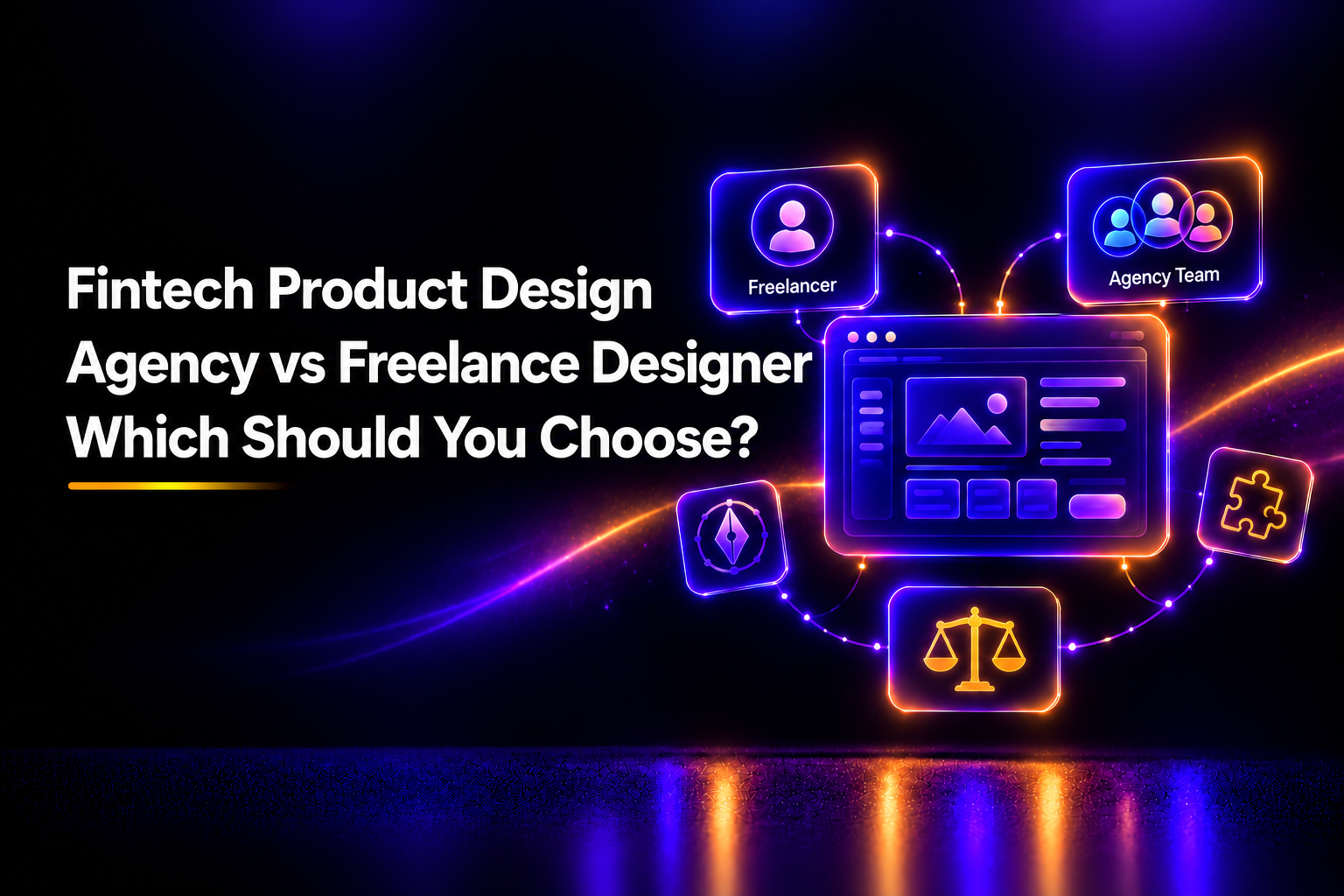
Choosing a design partner for a fintech product isn’t simply a question of whether to hire an agency or a freelancer. The right choice depends on what you’re building, how complex the product is, what capabilities you already have in-house, and how much support you need beyond UI design.
A freelance designer can be an excellent choice for focused design requirements or to extend an existing product team. A fintech product design agency, on the other hand, can bring together research, UX strategy, product thinking, UI design and other specialist capabilities under one team.
For fintech products, this distinction matters because financial experiences often involve complex user journeys, sensitive information, compliance requirements and high expectations around trust and usability. This article compares both options across expertise, research, scalability, timelines, cost and product complexity to help you make a more informed decision.
What Makes Fintech Product Design Different?
Before comparing a freelancer with a fintech UX agency, it is worth understanding why designing financial products can require a broader skill set than general UI design.
Fintech Products Have Complex User Journeys
A fintech product may involve several interconnected journeys, from onboarding and KYC to payments, transactions, investments, account management and customer support.
For example, a seemingly simple investment action may involve:
Discover → Understand → Verify → Invest → Confirm → Track → Manage
Each stage needs to be clear and predictable because users are making decisions involving their money and personal information.
Design Has to Balance More Than Visual Appeal
A strong fintech product design isn’t just about making an app look polished. Designers also need to consider:
- Trust: Does the product feel credible and reliable?
- Usability: Can users complete financial tasks without confusion?
- Security: Are important actions and risks communicated clearly?
- Clarity: Can users understand financial information and terminology?
- Compliance: Can mandatory requirements be incorporated without creating unnecessary friction?
This is why fintech design projects can sometimes require research, product strategy and UX expertise alongside visual design.
Fintech Product Design Agency vs Freelancer: At a Glance
Both options can work well, but they typically suit different types of projects.
| Factor |
Freelance Designer |
Fintech Product Design Agency |
| Expertise |
Individual area of expertise |
Multiple specialists |
| Research |
Depends on the designer |
Usually broader research capability |
| Strategy |
Depends on scope and experience |
Product and UX strategy can be integrated |
| Team |
Usually one primary designer |
Multidisciplinary team |
| Scalability |
Can be limited by individual capacity |
Easier to scale resources |
| Complex products |
Depends heavily on individual experience |
Better suited to multi-layered projects |
| Timelines |
Flexible for focused work |
Can support parallel workstreams |
| Cost |
Generally lower |
Higher investment, with broader capabilities |
| Ongoing support |
Depends on availability |
Usually broader support capability |
The important point is that neither option is universally better. The right choice depends on the scope and complexity of your product.
When a Freelance Designer Makes Sense
A freelancer can be a strong choice when the design requirement is clearly defined and the project doesn’t require a large team.
For Focused Design Requirements
If you need a specific set of screens, a visual refresh or additional design capacity for an existing product team, a freelancer can often work efficiently.
For example, a fintech company may already have its product strategy, user research and UX flows in place but need someone to redesign its mobile dashboard or create a new set of transaction screens. In such cases, bringing in an experienced fintech designer in India can be more practical than engaging a full agency.
When You Already Have Product Strategy and Research
Freelancers can work particularly well when an internal team already includes product managers, researchers, developers and design leadership.
The freelancer becomes an extension of that team rather than being responsible for the entire product design process.
When Budget Is a Major Consideration
Freelancers generally have lower overhead than agencies, which can make them attractive for smaller or well-defined projects.
However, the comparison shouldn’t stop at the initial quote. If the project later requires UX research, additional designers, usability testing or strategy, the overall cost and timeline can change.
When a Fintech Product Design Agency Makes More Sense
An agency becomes more valuable when the problem extends beyond designing individual screens.
When the Product Needs More Than UI Design
A complex fintech product may require several stages:
Research → UX strategy → User journeys → Information architecture → UI design → Design system → Developer handoff
A fintech product design agency can bring these capabilities together rather than requiring the company to coordinate several independent specialists.
This can be particularly useful for a new fintech product where the team is still defining the experience rather than simply executing an established design direction.
When You Need Fintech-Specific Expertise
Fintech design involves decisions around trust, financial information, security and user behaviour that aren’t always obvious from the interface alone.
For example, a payment product needs to make transaction amounts, fees, confirmation and failure states clear. An investment platform may need to present risk, portfolio performance and financial data without overwhelming users.
A designer or agency with relevant fintech experience is more likely to recognise these challenges early.
When Multiple Workstreams Need to Move Together
An agency can be useful when web and mobile products, multiple user roles or several product journeys need to be designed simultaneously.
Instead of one designer moving sequentially from one task to another, a multidisciplinary team can divide work while maintaining a common design direction and system.
7 Factors to Consider Before Choosing
1. Fintech Expertise
Don’t evaluate a potential partner only by looking at how attractive their portfolio is.
Look for evidence that they understand the type of financial product you’re building.
A designer who has worked on consumer apps may produce excellent interfaces but still need time to understand the requirements of a wealth-management platform, lending product or payment system.
Ask:
Have they solved problems similar to ours?
Relevant experience in areas such as WealthTech, payments, lending, banking or InsurTech can reduce the learning curve and help the team anticipate common UX challenges.
2. Research and UX Strategy
The difference between a screen designer and a product design partner often becomes visible before the first screen is created.
For a new product or major redesign, research can help answer:
- Who are the users?
- What are their biggest pain points?
- Which journeys matter most?
- How do competing products solve similar problems?
- Where are users likely to drop off?
- What information do users need before making a financial decision?
A freelancer can absolutely provide this capability if they have the relevant experience. But if research, strategy, UX and UI all need to happen together, an agency may offer greater breadth.
3. Complexity of Your Product
The complexity of the product should strongly influence the decision.
A landing page or a small fintech app redesign may not require a large team.
A platform involving KYC, payments, multiple account types, dashboards, transactions, admin systems and several user roles is a different proposition.
The more interconnected the product journeys, the more useful it can be to have multiple specialists working together.
4. Multidisciplinary Capabilities
Ask whether you need expertise beyond UX and UI.
Depending on the project, this could include:
- UX research
- Product strategy
- UX/UI design
- Information architecture
- Design systems
- Branding
- Content and microcopy
- Developer collaboration
If you only need one of these capabilities, a freelancer may be enough.
If several are required, a fintech app design agency can reduce the need to manage multiple independent contributors.
5. Scalability
Think about what happens after the initial project.
Will you eventually need:
- More product flows?
- Mobile and web versions?
- Multiple user roles?
- New financial products?
- New features?
- Ongoing design support?
A freelancer can scale through additional collaborators, but this depends on their availability and network. An agency generally has more flexibility to add resources as the scope grows.
This is particularly relevant for fintech startups that are still building their product roadmap. The design requirement six months from now may look very different from the requirement today.
6. Timeline and Availability
A freelancer may offer greater flexibility for a focused project, while an agency can often distribute work across several team members.
For example, if a fintech company needs user research, a new onboarding flow and a dashboard redesign at the same time, a team-based model may help move those workstreams forward in parallel.
But don’t assume an agency is automatically faster. Ask how many people will actually work on the project, how feedback is managed and what dependencies could affect delivery.
The relevant question is not simply:
“How quickly can you design it?”
It is:
“How quickly can you take the product from the current state to a validated, usable design?”
7. Cost vs. Overall Value
Cost is often the first comparison companies make, but it shouldn’t be the only one.
A freelancer may have a lower project fee, while an agency may include research, strategy, multiple specialists, design systems and ongoing support.
Consider the total value of the engagement:
Initial design cost + research + revisions + additional specialists + handoff + future design requirements
A lower upfront cost can become less attractive if the project later requires several additional specialists.
At the same time, an agency isn’t automatically better simply because it costs more. If your requirement is limited to designing 10–15 screens, paying for capabilities you don’t need may not make sense.
What About Hiring a Fintech Designer in India?
India has a large pool of freelance and agency design talent, but location alone shouldn’t be the deciding factor.
When an Individual Designer Makes Sense
A fintech designer in India can be a good fit when you need:
- Focused product design execution
- Additional capacity for an existing team
- A clearly defined set of screens or flows
- Short-term design support
The key is to evaluate actual fintech experience rather than relying only on general UI/UX experience.
When to Look for a Fintech UX Agency
A fintech UX agency makes more sense when the project requires a combination of strategy, research, UX and execution.
For example, if you’re redesigning a wealth-management platform and need to rethink the information architecture, user journeys, dashboard experience, mobile product and design system, a broader team can provide more value than a single specialist working alone.
Questions to Ask Before Hiring a Fintech Design Partner
A portfolio review is only the starting point. Ask questions that reveal how the designer or agency actually approaches financial products.
About Experience
- Have you worked on similar fintech products?
- Can you show relevant case studies?
- What specific user or business problem did you solve?
- How did you measure whether the redesign worked?
About Process
- How do you conduct research?
- How do you approach complex financial workflows?
- How do you validate UX decisions?
- How do you handle usability testing and feedback?
About the Team
- Who will actually work on the project?
- Will we have a dedicated designer?
- Is research or product strategy included?
- Can additional specialists be brought in if required?
About Delivery
- How do you manage timelines?
- How are feedback and revisions handled?
- How do you work with developers?
- What does the final handoff include?
These questions can reveal whether you’re hiring someone to produce screens or a partner who can help solve the underlying product problem.
Agency or Freelancer: Which One Is Right for You?
There is no universal answer. The right choice depends on the product and your existing team.
Choose a Freelancer If:
- Your scope is clearly defined
- You need focused design execution
- You already have product strategy and research
- You have an internal product team
- You need additional short-term capacity
- Budget is a major consideration
Choose a Fintech Product Design Agency If:
- You’re building or redesigning a complex fintech product
- You need research and product strategy
- Multiple user journeys or platforms are involved
- You need several design capabilities
- The product is expected to scale
- You want one partner responsible for a broader design process
The decision becomes easier when you start with the problem you need solved, rather than the type of vendor you want to hire.
How Design Brewery Approaches Fintech Product Design
At Design Brewery, fintech product design goes beyond creating individual screens. The approach combines product thinking, UX, UI and design strategy to make complex financial experiences easier to understand and use.
From Product Audit to Scalable Design
The process can include reviewing existing products and user journeys, identifying usability gaps, simplifying information architecture and creating scalable design systems.
The objective is to make the product easier for users today while giving the design system enough flexibility to support future features and financial products.
Example: Wealthy Nivesh
Our work with Wealthy Nivesh included brand strategy, brand identity, website design and a comprehensive product redesign across web and mobile.
The product served a diverse wealth-management audience and involved complex financial information. The redesign focused on creating intuitive user flows, reducing jargon and clutter, and developing a modular design system that could support future asset classes.
It is a good example of where the requirement extends beyond UI execution into product thinking, UX strategy, information architecture and scalable design.
Conclusion
Choosing between a freelancer and a fintech product design agency shouldn’t come down to which option is cheaper or which portfolio looks better.
A freelancer can be the right choice when you have a focused requirement and an established product team around them. An agency can be more valuable when the project involves research, strategy, multiple user journeys, specialist expertise and long-term scalability.
The most important question is therefore:
What does your fintech product actually need to succeed?
If the answer is focused design execution, a skilled freelancer may be all you need. If the answer involves solving complex product problems from research through execution, a multidisciplinary fintech design partner may be the better fit.
The right partner is ultimately the one that understands your product, your users and the complexity of financial experiences—and can turn that complexity into a clear, trustworthy and usable product.