Choosing a fintech UX design agency in India is more than finding a team that can create polished interfaces. Financial products involve money, sensitive information, complex workflows, security requirements, and high expectations around trust. A design decision that seems minor on screen can influence whether users complete KYC, understand an investment, trust a transaction, or seek customer support.
This is why fintech companies need a design partner that understands both UX and the financial product behind it.
The right agency should be able to understand your users and business, identify friction in existing journeys, work within regulatory and technical constraints, create scalable design systems, and collaborate closely with engineering teams.
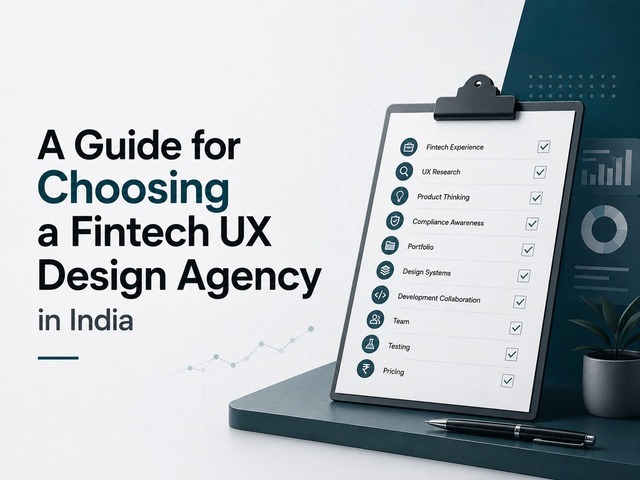
When evaluating a fintech UX agency in India, look beyond the visual quality of its portfolio. Examine the agency’s fintech experience, research methodology, product thinking, compliance awareness, development collaboration, team structure, and pricing.
Most importantly, look for evidence that the agency has solved real financial-product problems and taken those solutions from strategy and research through design and implementation.
1. Look for Relevant Fintech Experience
A strong fintech UX design agency in India should have experience solving problems specific to financial products. Experience designing general SaaS, ecommerce, or consumer apps can be valuable, but fintech introduces additional complexity around financial data, trust, security, compliance, and high-stakes user decisions.
Start by looking at the agency’s experience across relevant fintech categories such as:
- Wealth management and investment platforms
- Digital banking and neobanking
- Payments and digital wallets
- Lending and credit products
- Insurance
- B2B financial platforms
- Personal finance applications
More importantly, evaluate what the agency actually solved. A portfolio filled with attractive finance-themed screens does not necessarily demonstrate fintech expertise. Look for evidence of research, complex user journeys, financial data presentation, edge cases, scalability, and products that were actually implemented.
Design Brewery Putting Fintech Experience Into Practice for Wealthy Nivesh
Design Brewery’s work with Wealthy Nivesh is an example of this approach. The project involved brand strategy, brand identity, website design, and a comprehensive product redesign across web and mobile for a wealth management platform serving HNI investors across Indian metros and Tier 2 cities.
The challenge went beyond creating a more modern interface. Wealthy Nivesh wanted to build a “Phygital 2.0” wealth management ecosystem that combined institutional-grade data with human-led relationship management.
Design Brewery began with a comprehensive product audit, reviewing the existing platform, annotating major screens through heuristic analysis, and reevaluating core user flows. The team also studied the competitive landscape across established wealth management firms, digital wealth platforms, bank-led players, and product-level investment platforms.
The redesign then focused on making complex wealth management journeys more intuitive and scalable. Design Brewery developed a modular, card-based design system capable of supporting future asset classes and addressed the challenge of bringing internal and external portfolio information together.
The result was a shift from a primarily transactional interface toward a more holistic wealth management companion, with cleaner information architecture, simpler financial communication, and a more scalable product foundation.
This is the kind of evidence to look for when evaluating a fintech design agency: not just whether it can design financial interfaces, but whether it understands the product, users, financial information, business model, and complexity behind those interfaces.
2. Evaluate the Agency’s UX Research Process
Good fintech UX starts before the first screen is designed. A capable agency should first understand what is wrong, who is experiencing the problem, and why it exists.
Ask an agency to explain what happens during its discovery and research phase. Depending on the project, this could include:
- Stakeholder and expert interviews
- Existing product audits
- Heuristic evaluation
- User interviews and usability testing
- Competitor analysis
- Analytics and behavioral data
- Customer support or feedback analysis
- User journey mapping
- Information architecture analysis
Ask What Happens Before the First Design Screen
If an agency moves directly from a brief to high-fidelity screens, ask what assumptions those designs are based on.
A strong fintech UX agency in India should first understand:
- Who the users are
- What they are trying to accomplish
- Where they currently struggle
- What the business needs to achieve
- What technical constraints exist
- Which compliance or security requirements affect the journey
This is particularly important when redesigning an existing financial product. Without understanding the existing experience and its problems, a visual redesign can simply make the same underlying UX issues look more polished.
Check Whether They Study Real User Journeys
Research should extend beyond the happy path.
For a fintech product, this could mean examining what happens when:
- KYC verification fails
- A payment is declined
- A transaction remains pending
- A user enters incorrect information
- A document cannot be verified
- A user needs to recover an account
A customer disputes a transaction
These moments often have a greater impact on trust than the primary screens themselves.
A good agency should therefore be able to explain how it identifies and resolves friction across the complete financial journey, rather than focusing only on individual screens.
3. Assess Product Thinking, Not Just UI/UX Skills
A fintech design agency should be able to think beyond “How should this screen look?” and ask “What is the best way for this product to solve the user’s problem?”
This distinction is important because financial products often have complex features, multiple user types, large amounts of data, and interconnected journeys.
A product-oriented agency should consider:
- User needs and behaviors
- Business objectives
- Product priorities
- Information architecture
- Feature relationships
- Technical constraints
- Scalability
- Success metrics
Design Brewery’s work with Wealthy Nivesh demonstrates this product-level approach. The project involved more than refreshing the interface. The team addressed how different portfolio information could be brought together and created a modular product architecture that could accommodate additional asset classes as the business expanded.
Does the Agency Challenge Assumptions?
A good design partner should be willing to question an existing flow when research suggests a better solution.
For example, if a client asks to redesign a dashboard, the agency should be able to investigate whether the underlying issue is actually:
- Too much information
- Poor information hierarchy
- Missing user actions
- An unclear navigation structure
- Incorrect prioritization of features
- A fragmented journey
This is where fintech product design becomes more valuable than simply producing UI screens.
Can They Connect UX to Business Outcomes?
The agency should also understand how design improvements connect to measurable product outcomes.
Depending on the product, relevant metrics could include:
Onboarding completion
- KYC completion
- Time to first transaction
- Payment success rate
- Feature adoption
- User retention
- Support requests
- Task completion
- Transaction errors
The objective is not to promise a specific improvement before understanding the product. Instead, the agency should establish which user and business metrics matter and how UX can influence them.
4. Check Compliance and Financial-Domain Awareness
A fintech UX agency does not need to replace your legal or compliance team, but it should understand how regulatory and security requirements shape the user experience.
Financial products may need to account for KYC, consent, privacy, authentication, disclosures, risk communication, transaction verification, and other requirements. If these considerations are introduced only after the UX is complete, they can force major changes to the user journey.
A capable fintech design agency in India should therefore be comfortable collaborating with your product, legal, compliance, security, and engineering teams from the beginning.
Can They Design Within Regulatory Constraints?
Ask the agency how it approaches flows where compliance is an integral part of the experience.
For example, an onboarding journey may need to collect identity information, obtain consent, verify documents, and communicate specific information to the user. The design challenge is to satisfy those requirements while keeping the experience understandable.
The agency should be able to demonstrate how it incorporates these requirements into:
- User journeys
- Information architecture
- Forms and data collection
- Consent flows
- Disclosures
- Authentication
- Transaction confirmation
- Error and recovery states
The goal is not to hide compliance. It is to make necessary requirements clear and manageable for the user.
Ask How They Handle High-Risk Financial Flows
Pay particular attention to how the agency approaches journeys involving money or sensitive information.
Ask to see examples of how they have handled:
- KYC and identity verification
- Payments and transfers
- Investment decisions
- Financial disclosures
- Authentication
- Fraud or suspicious activity
- Failed transactions
- Account recovery
These flows reveal whether an agency understands the responsibility that comes with financial product design.
5. Review the Portfolio Like a Product Team
When evaluating a fintech UX agency India, don’t judge its portfolio only by asking, “Do these screens look good?”
A strong portfolio should help you understand the problem, the process, the design decisions, and the outcome.
Look for case studies that explain:
Challenge → Research → UX strategy → Design → Testing → Implementation → Outcome
Look Beyond the Hero Screens
Beautiful dashboards and polished landing screens are easy to showcase. The more revealing work is often hidden in the less glamorous parts of a product.
Ask whether the portfolio demonstrates:
- Empty states
- Loading states
- Error states
- Failed payments
- KYC failures
- Form validation
- Confirmation screens
- Transaction details
- Complex data tables
- Responsive experiences
- Accessibility considerations
These details demonstrate whether the agency has designed for real-world product usage, rather than simply creating presentation-ready concepts.
Design Brewery’s Wealthy Nivesh project, for example, involved a complete product audit before the redesign. The work moved from evaluating the existing platform and core journeys to wireframes, high-fidelity UI and a scalable design system. This provides a much stronger indication of product capability than showcasing isolated interface screens.
Check Whether the Work Was Actually Implemented
A useful question to ask is:
“What happened after the designs were approved?”
Find out whether the product was developed and launched, whether the agency collaborated with engineers, and whether the design was maintained through implementation.
This matters because a design that looks excellent in Figma can encounter very different challenges during development.
A strong fintech UX design agency in India should be able to demonstrate experience taking designs through the practical realities of product development.
Look for Evidence of Outcomes
Where possible, look for measurable outcomes or meaningful product improvements.
These could include:
- Improved onboarding completion
- Reduced task friction
- Better feature adoption
- Lower support volume
- Improved transaction success
- Higher engagement
A scalable product architecture
Not every design project will have publicly shareable metrics, particularly in financial services. In such cases, the agency should still be able to explain what changed in the product and why those changes mattered.
6. Look for Strong Design System Capabilities
A fintech product rarely remains small. New financial products, features, user types, asset classes, and regulatory requirements can continuously expand the interface.
This makes a design system an important consideration when choosing a fintech design partner.
A good design system provides reusable components and patterns that help maintain consistency as the product grows.
It should cover more than buttons and colors. For a financial product, the system may need patterns for:
- Forms and input fields
- Tables and financial data
- Cards
- Charts
- Notifications
- Alerts
- Authentication
- Transaction confirmations
- Error states
- Empty states
- Loading states
- Responsive layouts
Ask What Happens Beyond Figma
A scalable design system should be useful to developers as well as designers.
Ask whether the agency provides:
- Component specifications
- Interaction states
- Responsive behavior
- Design tokens
- Accessibility guidance
- Developer documentation
- Design QA during implementation
Design Brewery’s Wealthy Nivesh redesign is a good example of why this matters. The project introduced a modular, card-based design system designed to accommodate future asset classes without disrupting the interface.
This approach makes the product easier to scale while maintaining a consistent experience across its growing set of financial features.
7. Evaluate Development Collaboration
A strong fintech design should survive the transition from Figma to a functioning product. This makes development collaboration an important factor when choosing a fintech UX agency.
Designers need to understand technical constraints, while developers need enough context to implement the intended experience accurately.
Check Their Handoff Process
Ask how the agency works with your development team after designs are approved.
A good handoff should cover:
- Component specifications
- Responsive behavior
- Interaction states
- Form validation
- Error and empty states
- Animations and transitions where relevant
- Accessibility requirements
- Design system documentation
For fintech products, this level of detail is particularly important because small differences in implementation can affect how users understand financial information or complete sensitive actions.
Ask About Design QA
The agency’s involvement should ideally continue after development begins.
Design QA allows the team to compare the implemented product against the approved designs and identify issues such as:
- Incorrect spacing or hierarchy
- Missing interaction states
- Inconsistent components
- Broken responsive layouts
- Incorrect data presentation
- Accessibility problems
Ask whether designers participate in development reviews and how design changes are communicated when technical constraints require an alternative solution.
The best collaboration is not about designers dictating implementation. It is about design and engineering working together to deliver the intended user experience within technical realities.
8. Evaluate the Team You Will Actually Work With
An agency’s reputation and portfolio may help you shortlist it, but the quality of the project will ultimately depend on the people working on it.
During the evaluation process, ask:
- Who will lead the project?
- Who will conduct UX research?
- Who will be responsible for product strategy?
- How experienced are the designers?
- Will senior designers remain involved throughout the project?
- How frequently will you interact with the team?
- How will feedback and approvals be managed?
This is particularly important for fintech projects because domain knowledge builds throughout the engagement. A team that understands your product, users, regulatory constraints, and design system should ideally remain involved rather than being frequently replaced.
You should also understand the agency’s communication model. Clarify meeting cadence, documentation, review processes, decision-making responsibilities, and escalation paths before the project begins.
A capable fintech UX agency in India should function as an extension of your product team, with clear ownership and regular collaboration.
9. Compare Pricing Based on Value, Not Just Cost
Price is naturally an important factor when selecting a fintech design agency in India, but the lowest quote does not necessarily represent the lowest project cost.
A cheaper engagement can become expensive if it results in poor UX, repeated revisions, development rework, or a redesign shortly after launch.
Understand What the Fee Includes
Before comparing proposals, check whether the quoted price includes:
- Discovery and research
- Product audit
- UX strategy
- User flows
- Wireframes
- UI design
- Prototyping
- Usability testing
- Design system
- Developer handoff
- Design QA
- Post-launch support
Two agencies may quote very different prices because their scopes are completely different.
Understand the Pricing Model
Common models include:
- Fixed project: Suitable when scope and deliverables are clearly defined.
- Milestone-based: Payments are linked to specific stages such as research, UX, UI and development support.
- Monthly retainer: Useful when the product requires continuous design support.
- Dedicated team: Suitable for larger products requiring ongoing UX and UI capabilities.
Rather than asking only “How much will the redesign cost?”, ask:
“What level of expertise, research, design depth, testing and implementation support am I getting for this investment?”
For a financial product, the cost of getting UX wrong can include development rework, user drop-offs, support requests, delayed launches, and loss of trust. A strong agency should therefore be evaluated on the value and risk it brings to the project, not simply its initial quote.
10. Consider Starting With a UX Audit or Discovery Project
If you’re unsure whether an agency is the right fit, consider starting with a focused UX audit or discovery engagement before committing to a complete product redesign.
This can be particularly useful for established fintech products where the existing platform already has users, data, and workflows.
A focused audit can examine areas such as:
- Onboarding and KYC
- Core payment or transaction flows
- Dashboard usability
- Information architecture
- Financial data presentation
- Error and recovery states
- Mobile and responsive experiences
- Accessibility
- Design system consistency
The agency should then identify key usability issues, explain why they occur, and prioritize opportunities based on user impact and business importance.
This approach also gives you an opportunity to evaluate how the agency thinks, rather than judging it only by a sales presentation or portfolio.
Design Brewery followed a similar approach with Wealthy Nivesh, beginning with a comprehensive product audit and heuristic evaluation before moving into wireframes and the broader product redesign. This helped establish a clear understanding of the existing experience before design decisions were made.
Red Flags When Choosing a Fintech UX Design Agency
While evaluating agencies, watch for these warning signs:
1. A portfolio dominated by concept designs
If an agency shows attractive screens but cannot explain the product problem, research, implementation, or outcome, its fintech experience may be limited.
2. Starting with UI before understanding the product
A strong agency should be able to explain its discovery and research process before presenting visual solutions.
3. Limited understanding of financial journeys
If the team struggles to discuss KYC, payments, financial data, authentication, errors, or recovery flows, it may not have the required fintech expertise.
4. Treating compliance as an afterthought
Compliance requirements introduced late can result in significant UX changes and development rework.
5. No development collaboration
An agency that hands over Figma files and disappears may leave your engineering team to resolve important implementation questions on its own.
6. Focusing only on visual design
A fintech product needs more than attractive screens. Look for capabilities across research, UX strategy, product thinking, UI, design systems, testing, and implementation.
7. Unusually low pricing without a clear scope
A low quote may exclude research, testing, design systems, developer collaboration, or post-design support. Always compare the scope and expected outcomes, not just the final number.
Fintech UX Agency Evaluation Checklist
Before selecting a fintech UX agency India, use this checklist during your evaluation:
| What to Evaluate |
Questions to Ask |
| Fintech experience |
Have you designed products similar to ours? |
| UX research |
What research and audit activities happen before design? |
| Product thinking |
How do you connect UX decisions with product and business goals? |
| Compliance awareness |
How do you incorporate compliance and security requirements into UX? |
| Portfolio |
Can you show live fintech products and complete case studies? |
| Design systems |
Can you create a scalable system for future product growth? |
| Development collaboration |
How do you work with our engineering team during implementation? |
| Team |
Who will actually work on our project and how senior are they? |
| Testing |
How do you validate critical journeys and edge cases? |
| Pricing |
What exactly is included in the proposal and what happens if scope changes? |
The strongest agency will be able to answer these questions with specific examples rather than generic claims.
Final Takeaway
Choosing the right fintech UX design agency in India can have a direct impact on how effectively your financial product is adopted, understood, and trusted.
Look for a partner that combines fintech experience, UX research, product thinking, compliance awareness, scalable design systems, and strong development collaboration.
Design Brewery’s work with Wealthy Nivesh demonstrates this approach in practice, from auditing an existing wealth management platform and analyzing its competitive landscape to redesigning complex financial journeys and building a scalable product architecture.
The right fintech design agency in India should ultimately do more than make your product look better. It should help make the product easier to understand, easier to use, easier to scale, and more trustworthy for the people managing their money through it.