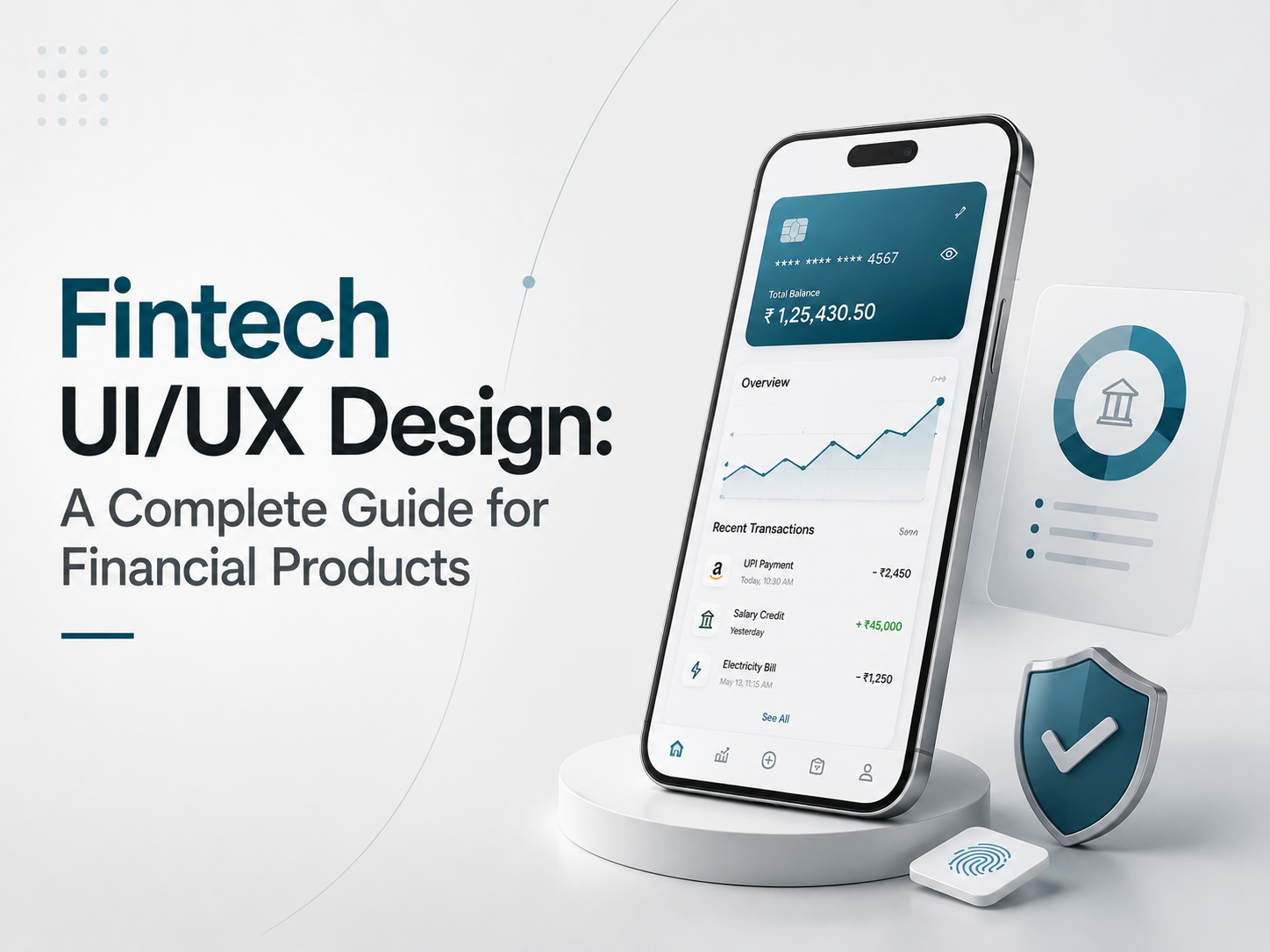
Financial products deal with money, sensitive information, and decisions that can have a direct impact on users. This makes design especially important in fintech.
A banking app, payment platform, lending product, or investment application needs to make complex financial processes feel simple while maintaining trust, security, and transparency.
This is where fintech UI/UX design plays a critical role. Beyond creating attractive interfaces, fintech design needs to consider financial data, user journeys, authentication, accessibility, and regulatory requirements.
Unlike many conventional digital products, fintech products cannot prioritize convenience alone. Users need to understand what they are doing, what happens next, and how their money and information are being protected.
This guide explores the key principles of fintech UX design, the role of fintech UI design, important financial user journeys, and the process of creating effective fintech product design.
What Is Fintech UI/UX Design?
Fintech UI/UX design is the process of designing digital financial products around user needs, business objectives, security requirements, and regulatory considerations.
UX design focuses on how the product works—how users navigate the product, complete tasks, and move through financial journeys.
UI design focuses on how the product looks and communicates information through layouts, typography, colors, components, charts, and interactions.
Fintech product design brings these disciplines together with product strategy, technology, security, and compliance.
It applies to products such as:
- Digital banking apps
- Payment and digital wallet platforms
- Lending and loan applications
- Investment and wealth management platforms
- Insurance products
- Personal finance applications
- B2B financial platforms
- Financial dashboards
For example, in a payment app, UX determines how a user moves from selecting a recipient to completing a transaction, while UI determines how the amount, recipient details, fees, confirmation, and transaction status are presented.
The goal is to create an experience that is clear, secure, predictable, and easy to use, even when the underlying financial processes are complex.
How Is Fintech UX Design Different From Conventional Digital Products?
The principles of UX design apply across digital products, but financial products require a higher level of clarity and control. A confusing experience in a food delivery app may cause frustration; in a fintech product, it can lead to a failed payment, financial loss, or loss of trust.
This makes fintech UX design more focused on trust, simplicity, security, accuracy, and transparency.
| Conventional Digital Products |
Fintech Products |
| Primarily focus on convenience and engagement |
Balance convenience with security and trust |
| Errors may have limited consequences |
Errors can affect money and financial decisions |
| Information is often easier to simplify |
Financial data can be complex and sensitive |
| Security may remain largely invisible |
Security needs to be clearly communicated |
| Users can often experiment freely |
Users need confidence before taking financial actions |
| Fewer regulatory requirements influence UX |
Compliance can directly shape user journeys |
Trust Is Part of the Experience
Users need to trust a fintech product before sharing personal information or moving money through it. Clear pricing, transparent terms, consistent branding, security indicators, and predictable interactions all contribute to that trust.
For example, showing transaction fees before confirmation gives users greater confidence than revealing them at the final step.
Simplicity Matters
Financial products often involve complex concepts such as interest rates, fees, repayment schedules, investment returns, and transaction limits.
Good fintech product design makes these concepts easier to understand through:
- Clear and simple language
- Strong information hierarchy
- Shorter forms
- Contextual explanations
- Progressive disclosure
- Useful data visualizations
The objective is to make complex financial processes easier to navigate without hiding important information.
Security Must Be Built Into UX
Authentication, OTPs, biometrics, transaction confirmation, fraud alerts, and device verification are essential parts of many financial products.
The challenge is to provide appropriate security without creating unnecessary friction. Users should understand why verification is required and what they need to do at each step.
Financial Data Needs Thoughtful Presentation
Fintech products can display balances, transactions, investments, spending patterns, loan information, and other financial data on the same interface.
Effective fintech UI design uses hierarchy, charts, summaries, filters, and progressive disclosure to help users find and understand the information that matters most.
Every Journey Needs a Clear Outcome
A financial journey should clearly communicate:
What am I doing? → What happens next? → Did it work? → What can I do now?
Whether the user is making a payment, completing KYC, applying for a loan, or reviewing an investment, each step should provide clear feedback and direction. This reduces uncertainty and builds confidence throughout the experience.
Key Principles of Effective Fintech UX Design
Good fintech UX design makes financial products easier to understand and use while maintaining the trust and control users expect. A few principles are particularly important.
1. Prioritize Clarity
Financial terminology can make interfaces difficult to understand. Use simple language, clear labels, strong information hierarchy, and contextual explanations to make complex concepts easier to navigate.
For example, a loan interface should clearly present the loan amount, interest rate, monthly repayment, fees, and repayment period instead of overwhelming users with technical terminology.
2. Be Transparent
Users should understand important financial information before they complete an action.
Make details such as these easy to find:
- Fees and charges
- Interest rates
- Transaction limits
- Terms and conditions
- Risks and eligibility requirements
Transparency reduces uncertainty and strengthens trust.
3. Build Confidence Into Every Action
Before users make an important financial decision, they should have an opportunity to review the details.
For a money transfer, for example, the confirmation screen should clearly show the recipient, amount, fees, and other relevant information before the transaction is completed.
4. Reduce Friction Without Compromising Security
Fintech products need to balance convenience with necessary security controls.
Progressive onboarding, pre-filled information where appropriate, biometric authentication, and clear verification steps can reduce unnecessary friction while maintaining appropriate security.
5. Design for Errors and Recovery
Financial products need clear experiences for situations such as failed payments, incorrect OTPs, insufficient funds, verification failures, and network issues.
Instead of simply displaying an error, explain:
What happened → Whether the money was affected → What the user should do next.
This is particularly important because uncertainty around a financial transaction can quickly damage user trust.
6. Design for Accessibility
Fintech products should work for users with different abilities, ages, languages, and levels of financial and digital literacy.
Readable typography, sufficient contrast, accessible forms, clear labels, appropriate touch targets, and understandable data visualizations can make the experience more inclusive.
Overall, effective fintech product design combines simplicity and accessibility with the clarity, security, and transparency required when users are dealing with their money.
Designing Financial User Journeys
A fintech product is made up of multiple connected financial journeys, from registration and KYC to payments, investments, and customer support. Fintech UX design should consider the complete journey rather than designing each screen separately.
A typical journey can follow:
Discover → Sign up → Verify → Onboard → Take financial action → Confirm → Track → Get support
Each stage should clearly communicate what the user needs to do, what happens next, and whether the action was completed successfully.
Account Opening and Onboarding
The onboarding experience should explain what information is required, why it is needed, and how long the process may take.
Progressive onboarding can help avoid overwhelming users with a long form at the beginning.
KYC and Verification
- KYC is often one of the more complex parts of a fintech journey. The interface should clearly explain:
- Required information and documents
- Why verification is needed
- How documents should be submitted
- Verification status
- What happens if verification fails
Clear instructions and progress indicators can reduce friction during the process.
Payments and Money Transfers
Payment journeys need particularly careful design because users need confidence that their money is going to the correct destination.
A typical flow is:
Select recipient → Enter amount → Review → Authenticate → Confirm → Track transaction
The confirmation step should make important details such as the recipient, amount, and applicable fees easy to verify.
Loans and Investments
Loan applications can involve eligibility checks, forms, document submission, verification, approval, and repayment. A clear progress indicator and application status can help users understand where they are in the process.
Investment products have a different challenge: users need to understand performance, risk, fees, returns, and portfolio information before making decisions.
In both cases, fintech product design should simplify the journey while providing the information required for informed decisions.
Post-Transaction Experience
The journey does not end after a payment or financial action is completed. Users may need to track a transaction, download a receipt, report a problem, or contact support.
Providing clear status updates, transaction details, and next steps creates a more complete and trustworthy experience.
The key principle is simple: every fintech journey should help users understand where they are, what they need to do, and what happened after they took an action.
Designing Financial Data for Better UX
Financial products often present users with large amounts of information, including balances, transactions, spending patterns, investment returns, and loan details. Fintech UI design should organize this information so users can understand it quickly and take the right action.
Create a Clear Information Hierarchy
Not every piece of information needs the same level of emphasis. A banking dashboard, for example, may prioritize:
- Available balance
- Recent transactions
- Upcoming payments
- Alerts
- Spending insights
Secondary information can be placed deeper within the interface, allowing users to explore it when needed.
Make Data Easy to Interpret
Charts, graphs, progress indicators, and category breakdowns can help users understand financial information more quickly.
However, every visualization should have a clear purpose. Users should be able to understand what the data represents, the relevant time period, and any important context without having to interpret a complicated graphic.
Design Transaction History for Scanning
Transaction history should make essential details easy to identify, such as:
- Date
- Amount
- Merchant or recipient
- Transaction type
- Status
- Reference information
Search and filters become particularly useful when users have a large number of transactions.
Add Context to Financial Numbers
Numbers are more useful when users understand what they represent.
Instead of displaying only:
₹50,000
the interface can provide context:
Available balance: ₹50,000
Similarly, information such as monthly spending, portfolio value, loan repayment, or payment due date should be clearly labeled.
Keep Personalization Useful
Fintech products can use financial data to surface relevant insights such as spending patterns, savings progress, upcoming payments, or unusual transactions.
Personalization should help users understand and manage their finances rather than simply adding more information to the interface.
The goal of effective fintech product design is to turn complex financial data into information that users can quickly understand, trust, and act upon.
Security and Trust in Fintech UI Design
Security is a core part of the fintech experience. Users need to know that their money and personal information are protected, while security processes should remain easy to understand.
This makes security both a technical requirement and an important part of fintech UI/UX design.
Make Authentication Clear
Fintech products may use passwords, PINs, OTPs, biometrics, or multi-factor authentication. The interface should clearly explain:
- Why verification is required
- What the user needs to do
- Where an OTP or code was sent
- What happens if verification fails
- What options are available if the user cannot complete verification
Clear instructions can make security steps feel less disruptive.
Make Transaction Confirmation Predictable
Before completing an important transaction, users should be able to review critical information such as:
- Recipient
- Amount
- Fees
- Payment method
- Transaction details
A clear confirmation step gives users an opportunity to identify mistakes before money is transferred.
Make Security Alerts Actionable
Security notifications should explain what happened and what the user can do.
For example, instead of a generic “Suspicious activity detected”, an alert can identify the type of activity and provide an appropriate action, such as reviewing a new login or securing the account.
Give Users Security Controls
Where appropriate, users should be able to manage:
- Logged-in devices
- Authentication methods
- Security credentials
- Transaction limits
- Account activity
- Security notifications
This gives users greater visibility and control over their accounts.
Balance Security With Usability
Not every action requires the same level of authentication. Security requirements can vary based on factors such as transaction value, user behavior, device, and risk level.
Effective fintech product design works with security and compliance teams to integrate the required controls without creating unnecessary friction throughout the user journey.
Regulatory and Compliance Considerations in Fintech Product Design
Regulatory requirements can directly influence how users interact with a financial product. KYC, consent, privacy, disclosures, authentication, and accessibility requirements may all affect the user journey.
For this reason, compliance should be considered early in the fintech product design process rather than added after the interface is complete.
KYC and Identity Verification
KYC requirements can add several steps to onboarding. The UX should make the process clear by explaining:
- What information is required
- Why it is needed
- Which documents are accepted
- How verification works
- What happens if verification fails
Progress indicators and clear error messages can reduce unnecessary friction.
Consent and Privacy
Fintech products handle sensitive personal and financial information. Users should understand what information is being collected, why it is required, and how it will be used where consent is applicable.
Privacy information should be presented in clear language and at the appropriate point in the user journey.
Fees and Financial Disclosures
Users should be able to understand relevant fees, interest rates, repayment terms, risks, and other important conditions before completing a financial action.
For example, a lending interface may need to clearly communicate the interest rate, processing fee, repayment amount, tenure, and applicable charges.
Risk Communication
Investment and other financial products may require users to understand potential risks before making decisions.
Instead of overwhelming users with lengthy information, fintech UI design can use clear summaries, contextual explanations, expandable details, and links to complete documentation.
Design Compliance Into the Experience
A common mistake is to design the ideal user journey first and introduce compliance requirements later. This can result in additional screens, repeated information requests, and unnecessary friction.
Involving compliance and legal teams during discovery and journey mapping allows requirements to be incorporated while maintaining a clear and usable experience.
The goal is to make compliance clear and integrated rather than disruptive to the overall fintech experience.
The Fintech Product Design Process
A structured design process helps fintech teams balance user needs with business goals, technology, security, and compliance.
Step 1: Product and Business Discovery
Start by understanding the product, target users, business model, key financial services, and product objectives. Identify the security, technology, and regulatory requirements that could influence the experience.
Step 2: User Research
Research helps identify user needs, financial behaviors, pain points, and expectations. This can include user interviews, surveys, competitor analysis, analytics, and existing customer feedback.
Step 3: Regulatory & Compliance Discovery
Identify requirements such as KYC, authentication, consent, privacy, financial disclosures, accessibility, and data protection before designing detailed user flows.
Step 4: User Journey Mapping
Map important journeys such as account opening, KYC, payments, lending, or investments. Identify the user’s goals, required information, decision points, friction, security requirements, and expected outcomes.
Step 5: Information Architecture
Organize features and information so users can easily find what they need. For a banking app, this could include accounts, payments, transfers, cards, loans, investments, transactions, security, and support.
Step 6: Wireframing & Prototyping
Wireframes establish the structure of screens and flows before visual design begins. Prototypes can then be used to test important interactions and identify usability issues early.
Step 7: Fintech UI Design
The visual layer includes typography, colors, buttons, forms, cards, charts, navigation, notifications, and data visualizations. The interface should support the brand while maintaining clarity, accessibility, and consistency.
Step 8: Testing and Developer Handoff
Usability testing can reveal where users struggle with tasks such as completing KYC, making payments, or understanding financial information. Once validated, designs can be handed to developers with component specifications, interaction states, responsive behavior, and accessibility requirements.
Step 9: Post-Launch Optimization
Fintech design should continue after launch. Analytics, customer feedback, support queries, and usability testing can identify opportunities to improve onboarding, transaction completion, feature adoption, and overall usability.
Common Fintech UI/UX Design Mistakes
Even visually polished financial products can create poor experiences when they overlook the specific needs of fintech users.
1. Making Financial Information Difficult to Understand
Complex terminology, dense tables, and unclear labels can make financial products intimidating. Use simple language and clear information hierarchy.
2. Hiding Fees or Important Terms
Unexpected fees and unclear conditions can quickly damage trust. Present relevant charges, interest rates, risks, and terms before users commit to an action.
3. Creating Excessive Onboarding Friction
KYC may require significant information, but asking for everything at once can increase abandonment. Use logical steps, explain requirements, and show progress.
4. Ignoring Error and Failure States
Design for failed payments, incorrect OTPs, verification failures, insufficient funds, and network issues. Users should understand what happened and what to do next.
5. Overloading Dashboards
Adding too many balances, charts, transactions, notifications, and recommendations can make financial dashboards difficult to scan. Prioritize the information users need most.
6. Designing Only for Experienced Users
Not every user understands financial terminology or digital financial products. Clear language, contextual explanations, and progressive disclosure can make the experience more accessible.
7. Designing Screens Instead of Journeys
Individual screens may look good while the overall experience remains fragmented. Fintech UX design should connect registration, KYC, payments, notifications, and support into a coherent journey.
How to Choose a Fintech UI/UX Design Agency
Choosing a design partner requires evaluating more than visual design capabilities. The agency should understand financial products, user behavior, security, compliance, and complex product journeys.
Look for:
- Relevant fintech experience: Review work across banking, payments, lending, investments, insurance, or other financial products.
- UX research capabilities: Check whether the agency conducts research, journey mapping, usability testing, and competitor analysis.
- Financial product understanding: Ask how they would approach journeys such as KYC, payments, lending, or investment onboarding.
- Security and compliance awareness: The agency should be comfortable collaborating with product, security, legal, and compliance teams.
- Design systems: Check whether they can create scalable components and interaction patterns for growing products.
- Developer collaboration: Evaluate their approach to specifications, responsive behavior, accessibility, and implementation support.
- Post-launch optimization: A strong partner should be able to use analytics and user feedback to continuously improve the product.
The right fintech UI/UX design agency should be able to take a complex financial experience and make it clear, trustworthy, secure, and easy to navigate.
The Future of Fintech UI/UX Design
Fintech products are becoming more intelligent, personalized, and integrated into everyday digital experiences. This will continue to influence how financial products are designed and how users interact with them.
AI-Powered Financial Experiences
AI can help users understand financial information and complete tasks using natural language.
Users could ask questions such as:
- “How much did I spend this month?”
- “Show my upcoming payments.”
- “Explain my investment performance.”
These experiences need clear boundaries, accurate information, and transparent communication so users understand what the system can and cannot do.
More Personalized Experiences
Fintech products can use relevant financial data to provide personalized insights around spending, savings, investments, and payments.
The challenge for fintech UX design will be making personalization useful without overwhelming users or reducing their control over their information.
Conversational Interfaces
Chat-based interfaces can simplify certain financial tasks by allowing users to interact through natural language rather than navigating multiple menus.
For financial actions, however, conversational interfaces need clear confirmation and predictable interaction patterns before an action is completed.
Embedded Finance
Payments, lending, insurance, and other financial services are increasingly being integrated into ecommerce platforms, business software, marketplaces, and other digital products.
This means fintech design principles will increasingly need to work within experiences where financial services may not be the primary product.
Accessibility and Inclusion
Future financial products will need to serve users with different abilities, ages, languages, financial knowledge, and levels of digital confidence.
Accessible typography, clear interfaces, understandable financial information, and inclusive interaction patterns will become increasingly important.
The future of fintech product design is therefore less about adding technology for its own sake and more about using technology to make financial experiences clearer, more personalized, secure, and accessible.
Final Takeaway
Effective fintech UI/UX design goes beyond creating attractive interfaces. Financial products need to make complex processes easy to understand while maintaining trust, security, transparency, and user control.
A strong fintech experience brings together:
- User research
- UX strategy
- UI design
- Financial data visualization
- Security
- Compliance
- Accessibility
- Usability testing
- Continuous optimization
Whether you’re building a banking app, payment platform, lending product, investment application, or B2B financial platform, thoughtful fintech product design can help create experiences that users understand and trust.
The best fintech products make complex financial interactions feel simple, predictable, and secure without hiding the information users need to make informed decisions.